Hydro Jetting in Yonkers
Key Takeaways: Why a Wipe Mass Comes Back After Every Cabling
- Fiber does not dissolve. Across Yonkers, wipes, paper towel, cloth and dryer lint arrive in the line intact, and once a few pieces catch on something, everything after them catches too.
- An auger bores a hole through that mass and flow returns, which looks like a fix and is really a hole. The mass is still in the pipe and it closes again from the same edges.
- Hydro jetting breaks the mass apart and carries it out to the main, cleaning the full circumference of the pipe wall rather than the middle of it.
- Fiber needs a snag point, so it collects where the pipe is already imperfect: at a jointed clay seam, on tree roots, or on the rough face of scale in old cast iron. That is why the same Yonkers address keeps having the same problem.
- A video camera inspection runs first, to confirm the pipe can take high-pressure water and to find the snag point, and again afterward to prove the wall is clear.
- Grease makes it worse rather than causing it. Fat binds loose fiber into something solid, which is why descaling and degreasing a run buys more time than pulling the blockage did.
- A collapsed section, a badly offset joint or a wall thinned by corrosion rules out the work, and that answer is worth having before anything goes in.
- Roto-Rooter is fully licensed and insured, and answers across Yonkers 24/7, 365 days a year.
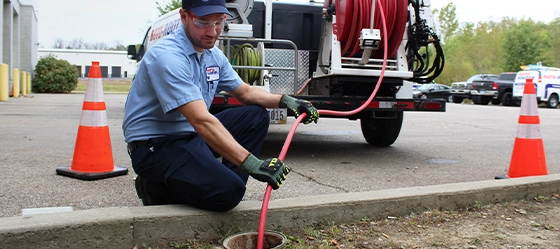
Pull a serious blockage out of a Yonkers sewer line and hold it up, and the surprising part is how much of it is cloth. Not food, not soil, not roots: wipes, shop towels, cleaning rags, cotton swabs and the lint that leaves a laundry room every week. Everything on that list is sold as disposable, and none of it comes apart in water.
A Hole Through a Rag Ball Is Not a Clean Pipe
The mechanics are worth understanding because they explain the repeat visit. An auger is a boring tool. Spun into a fibrous mass it winds a channel through the middle, flow comes back, and the household stops thinking about it. What has not happened is removal. The mass is still wrapped around whatever caught it, the channel is ragged at the edges, and the next wipe through hooks on those edges. The interval between calls gets shorter, and nothing about the pipe has changed except that it is now holding more material than it was.
Fiber also needs somewhere to start. A smooth, sound, well-pitched run will usually carry it all the way to the main. Trouble in a Yonkers lateral begins at an imperfection: the lip of a jointed clay section, fine tree roots at a seam, the rough face of mineral scale in old cast iron, or a joint that has shifted a fraction out of line. In Yonkers most laterals have at least one of those, because most of them have been in the ground a very long time.
What High-Pressure Water Does to Fiber
The hose carries a nozzle that throws water backward against the pipe wall while it is drawn along the run. Two things happen at once. The mass is cut apart and pushed toward the main rather than compacted, and the wall itself is scoured across its whole circumference, which takes away the grease and the deposit that were binding the fiber together. Mineral scale is cut back toward the original bore, the descaling half of the work, and root hair left at a joint after a cutter head comes away with everything caught on it.
That is the difference between clearing a blockage and cleaning a sewer line, and it is why Roto-Rooter treats end-to-end cleaning as the standard rather than an upgrade. Restoring flow is the emergency on any Yonkers call. Taking the wall back to bore is what removes the reason the fiber stopped there in the first place.
Serving Yonkers and surrounding communities, Including:
Counties in the Yonkers Area
What Rules Out the Hose Entirely
Cleaning assumes a pipe that can be cleaned. Three findings end the conversation. A collapsed length has no bore left to recover. A joint badly offset, one section shifted out of line with the next, will catch the hose and is a structural problem that no amount of cleaning addresses. A wall worn thin by decades of corrosion may not survive the work, and in the original cast iron under older Yonkers housing that is a real finding rather than a formality.
When one of those turns up, the honest answer is that the job in front of you is a repair, scoped from the footage the camera already recorded. For the rest of what the local team handles, Yonkers plumbers is where to start.
Buildings Where One Habit Affects Everybody
Line size and daily volume separate a house lateral from a commercial run, and both differ again from a small apartment building. A single household sets its own pace and a properly cleaned lateral can go a long time. A restaurant putting cooking waste down the same pipe through every service is working against a rate it cannot argue with, which is why food service operators across New York put the work on a calendar. A multi-unit building sits in between, and it has a wrinkle the others do not: one household's habits load a run that everyone shares, and the person who notices the problem is rarely the person who caused it.
How Does Hydro Jetting Get Fiber Out When an Auger Cannot?
By moving it rather than passing through it, which is the whole reason a Yonkers line behaves differently afterward. The stream comes off the nozzle backward, so the working force is directed along the pipe toward the main and against the wall, which cuts a mass apart and carries the pieces away instead of compacting them further down the run. At the same time the grease holding the fiber together is taken off the wall, so what is left has nothing to bind to and nothing to snag on. That is why the camera afterward matters. A clear picture of the wall is the proof that material left the pipe rather than simply moved along it.
If the run is backing up right now rather than slowly getting worse, start with emergency plumbing help in Yonkers. Getting the water going the right way comes first, and the cleaning decision follows once the immediate mess is handled.
Who Has to Say Yes Before the Hose Goes In
A technician locates the cleanout, runs the camera, and goes through the footage with whoever is authorizing the work before anything else happens. If the run is a candidate, the hose is drawn through it and the wall is cleaned back toward its original diameter, then the camera goes down a second time. Roto-Rooter provides on-site estimates before any work begins.
In a Yonkers two-family or a small apartment house that authorization is worth sorting out before the visit rather than during it, because the run being cleaned serves more than one Yonkers household and it is out of use while the hose is in it. The other practical variable is the cleanout itself: some were finished over during a conversion and some were never installed. Where none exists, the inspection covers what adding one would involve, since a line that has needed help twice will need it again.
Call About a Line That Keeps Closing in Yonkers
Roto-Rooter has been clearing and cleaning sewers across New York since 1935 and is fully licensed and insured. Call 914-920-4930 or schedule online to get a camera in the line and a straight account of what is holding it. Yonkers crews answer 24/7, 365 days a year, and you get the plumbing peace of mind of knowing rather than guessing.

When a Line Needs Hydro Jetting Rather Than Another Auger
Why Fiber Finds Something to Hold On To Here

SPECIAL FINANCING AVAILABLE
We have partnered with Synchrony Bank to offer financing options to make your plumbing repair expenses as convenient and stress-free as possible.