Hydro Jetting in Tampa
Key Takeaways: What Sand and a Shallow Water Table Leave Behind
- A line that closes again at the same depth is holding material, and a cable that restores flow through it has removed nothing from the pipe wall.
- Hydro jetting scours the full circumference of a sewer line back to the wall, which is why it answers recurrence rather than one slow fixture.
- Not everything in a fouled line went down a drain. Fine sand and grit enter through open joints, and on ground as flat as Tampa's they settle wherever the fall runs out.
- Grease, mineral scale, sediment and root hair left after a cutter head are four different problems, and a video camera inspection is what tells them apart.
- The camera goes down twice: before the hose, to prove the pipe can take pressure, and after it, to show the wall is genuinely clear rather than merely open.
- A collapsed or badly offset pipe is not a jetting candidate, and pressure applied to one buys nothing worth having.
- Roto-Rooter is fully licensed and insured, and answers in Tampa 24/7, 365 days a year.
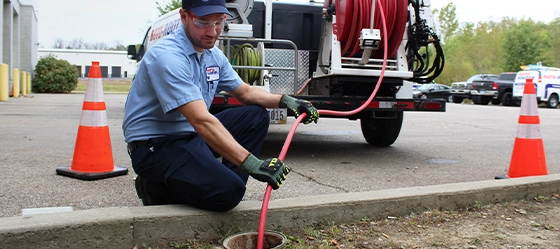
Not everything that blocks a sewer line went down a drain. A good share of what a camera finds under Tampa is sand: pale, fine and heavy, arriving through a cracked hub or a separated joint out of ground that is mostly sand to begin with. It travels only as far as the flow will carry it, drops out in the flattest part of the run, and holds whatever grease comes along behind it. A cable pushed through that makes an opening. Water returns, the problem looks solved, and the opening closes again at the rate the sand keeps arriving.
What the Hose Does That a Cable Cannot
Hydro jetting works the pipe wall instead of the middle of the blockage. A nozzle on the end of a hose directs high-pressure water backward against the wall while the hose is drawn through the sewer line, so the cleaning happens across the whole circumference and material moves back toward the access point rather than farther downstream. Sand and silt lift and flush out. Grease that cooled and hardened along the crown comes off. Mineral scale in older cast iron is cut back toward the original bore, which is the descaling half of the work, and root hair left at a joint by a cutter head is stripped away.
That difference is the entire argument for the service. Clearing a clog and cleaning a pipe are two jobs, and only one of them changes what happens next season.
Telling Sand From Grease Before Anything Starts
A video camera inspection comes first, and here it does two jobs at once. It identifies the material, because sediment, grease and roots each point at a different cause. It also examines the pipe itself, since sand inside a line means groundwater is getting in somewhere it should not, and the place it enters usually shows on the screen as a hairline crack, a hub that has lost its seal, or a joint that has pulled apart.
The camera goes back down at the end. A before-and-after on the same run is the only honest way to show a wall is clear, and it is worth asking any company for. It also settles the question that brings most people in Tampa to a second opinion, which is whether the last visit accomplished anything beyond a few good months.
Serving the entire Tampa metro area, Including:
Counties in the Tampa Metro Area
When the Answer Is a Repair Instead of a Cleaning
Sand can be washed out of a pipe. A pipe that has lost its shape cannot be washed back into it, and that is the boundary of this service. Three findings rule it out. A collapsed section has no bore left to clean. A joint badly out of line will catch the hose, and the problem there is structural rather than dirty. A pipe already thin from long corrosion may not survive the pressure, and the inspection is what reveals that before anyone finds out the expensive way. Jetting cleans. It does not repair, and any company that suggests otherwise is selling something.
When the camera finds one of those, the honest answer is that cleaning is not the fix, and what follows is a repair conversation. For a lateral running under a front yard in Tampa that can mean a trenchless repair rather than an open trench across the sod, and the discussion starts from footage that already exists.
Does Jetting Push the Sand Farther Down the Line?
It is the right question, and the answer is no when the work is done properly. The nozzle throws water backward, which is what pulls the hose forward and what moves loosened material toward the access point behind the head. Sediment comes back out at the cleanout rather than being driven toward the city main, which matters on a Florida run that keeps taking sand in. It is also why the direction a crew works matters, and why a run fouled with sand gets handled differently from one fouled with grease.
Commercial Runs Foul on a Schedule, Houses Do Not
A house lateral and a restaurant kitchen line differ in diameter, in load and in what it costs the owner when they close. A residential line in Tampa cleaned back to the wall can go years before it needs attention again, depending entirely on what caused the buildup. A kitchen putting fat and food solids through the same run every service is working against a rate it can measure, which is why food service operators across Florida tend to set an interval instead of waiting for a Friday night failure.
Both are ordinary work for Roto-Rooter. If you are not certain which plumbing problem in the building you are looking at, start from the Tampa plumbers page and work down from there.
Finding Where the Sand Gets In
Cleaning a line full of sediment without asking where the sediment came from buys a season in Tampa and no more than that. The same camera pass that shows the deposit usually shows the opening that fed it, and that opening is a repair decision rather than a cleaning decision. It can also be a small one. Somebody holding the footage can weigh it in their own time instead of under a backed-up house on a Sunday.
If the line is backing up right now rather than slowly getting worse, start with emergency plumbing help in Tampa. Restoring flow comes first and the cleaning conversation follows.
Sod, Lanais and Where the Access Point Went
Access is the practical variable. A cleanout sitting in the open makes for a short visit. One that has been sodded over, boxed in during a lanai or garage conversion, or never installed to begin with changes the approach, and it is worth saying so when you call rather than discovering it on the day. A fair number of houses in Tampa went up before an exterior cleanout was standard, and where there is none the inspection covers what adding one would take, since a line that has needed attention twice in Florida humidity and sand will need it a third time.
Schedule Hydro Jetting in Tampa
Roto-Rooter has been in business since 1935, is fully licensed and insured, and answers in Tampa 24/7, 365 days a year. Call 813-980-6000 or schedule online to put a camera in the line first. Roto-Rooter provides on-site estimates before any work begins, and knowing what is actually in the pipe is most of the plumbing peace of mind on offer here.

The Fouling Patterns a Jetting Truck Is Built For
Sand Under the Lot, Water a Few Feet Down

SPECIAL FINANCING AVAILABLE
We have partnered with Synchrony Bank to offer financing options to make your plumbing repair expenses as convenient and stress-free as possible.