Sewer and Water Line Excavation in Tampa
Key Takeaways: The Lawn Notices Before the Drains Do
- A soft, low or sinking patch of ground in a yard across Tampa, following the line of the sewer run, is worth taking seriously even when every fixture in the house is draining normally.
- Fine Florida sand does not sit still next to an opening. A cracked or separated pipe pulls soil in with the water, and the ground it came from has to go somewhere.
- What it leaves behind is a cavity around and above the pipe, which migrates upward over time until it reaches the surface and shows itself.
- A camera survey is what turns a suspicion into a finding. It shows where the opening is, how large it has become, and whether soil is already arriving inside the pipe.
- Waiting is what makes this expensive. The pipe repair barely changes, but the volume of ground that has to be made good keeps growing.
- Trenchless methods are conditional on depth, host-pipe condition and access at both ends, and a run that has been losing soil for a long time may not qualify.
- Utility locating happens before any dig, and where the responsibility for the run ends is a local rule to confirm rather than an assumption to make.
- Roto-Rooter is fully licensed and insured, and permitting and inspection are carried as part of the job.
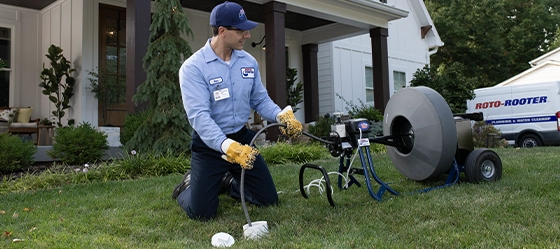
Homeowners in Tampa report this one in almost the same words every time. There is a place in the yard that feels different underfoot. The grass grows fine, nothing smells, the drains work, but the ground gives slightly when you walk on it, and it runs in a line. That is not a landscaping problem, and it arrives months before anything goes wrong indoors. Across Tampa it is one of the more common reasons a sewer call gets made at all.
Where the Sand Goes When a Lateral Opens Up
Picture what a break actually does in this soil. Water leaves the pipe through the opening, and because the surrounding ground is loose, fine and permeable, the water moving back and forth takes grains with it. Some of that material washes into the pipe and away down the line. Every grain that leaves is a grain that used to be supporting the ground above it. On the sandy ground under most of Tampa there is not much holding the rest of it in place.
The cavity that forms does not stay where it started. Loose sand collapses into it from above, which moves the empty space upward a little at a time, and the process repeats. By the time it is visible at the surface as a depression or a spongy patch, the pipe has usually been open for a long while. That is the part worth understanding: the lawn is not the early warning. It is the late one.
Is a Soft Patch in the Yard a Sewer Problem?
Not always, and the honest answer is that it has to be checked rather than assumed. Irrigation leaks do something similar. So does a downspout that has been discharging in the same place for years. The tell that points at the sewer is the shape: a soil-loss cavity over a lateral tends to run as a line or a series of dips following the pipe, rather than as a single round low spot.
A camera survey answers it properly. Running the line locates the opening, shows how wide it has grown, and reveals whether soil is arriving inside the pipe, which is the confirmation nothing else provides. It also settles the more important question, which is whether this is a defect a repair can address or a run that has reached the end of its life. Those look identical from the lawn.
Serving the entire Tampa metro area, Including:
Counties in the Tampa Metro Area
Locating Before an Excavation on Sandy Ground
Gas, electric, water and telecom are located and marked before ground opens anywhere in Tampa. It is a legal and safety requirement in Florida, it is arranged ahead of the crew rather than on the day, and close to a marked service the digging is done by hand. Loose sand makes that discipline more important, not less, because there is no resistance in the ground to warn an operator that a bucket has found something it should not have. Anyone offering to skip the locate to save half a day is offering to gamble on your behalf.
The work is permitted and inspected, and Roto-Rooter handles that process as part of the job. This page names no permit fee and no approval timeline, because both are set locally and both move with the scope of the specific work, and a figure published here would turn into a promise nobody authorized. Your on-site estimate covers it against the real job.
Filling the Void, Not Just the Excavation
This is where a soil-loss failure differs from every other kind, and it is the part that surprises people when they see the estimate. Replacing the pipe is the straightforward half, and in Florida sand it is usually quick. The other half is the ground that is no longer there. A cavity running alongside and above the old line has to be found, opened and filled with properly compacted material, or the new pipe gets bedded over a space that is still waiting to collapse.
That is also the argument against waiting once a survey has confirmed what is happening. The pipe repair is much the same job whether it is done now or later. The volume of missing ground is not, because it keeps growing for as long as water keeps moving past the opening, and every wet week adds to it. Backfill goes back in compacted lifts and the work is inspected against Florida plumbing code before the surface is closed.
The Handover to the City, and Why It Varies
Broadly, the run from the building out to the main belongs to the property owner and the main belongs to the municipality. The exact point where that changes, at the property line, at the curb, or at the connection itself, is set by local rule and differs between jurisdictions across the Tampa area, so it is worth confirming rather than assuming. It decides who pays for which length of pipe.
Roto-Rooter works on the property owner's side of that boundary. Municipal main work is not something a plumbing company undertakes, and where the survey places the fault past the connection, the next call goes to the city rather than to a contractor.
Does the Whole Run Need Sewer Line Replacement?
Not necessarily. Where the camera shows one opening with sound pipe on both sides of it, a spot repair reaches that length, restores the ground around it and leaves the rest alone. On a property where the surface has already been disturbed, keeping the excavation short is worth real money.
What argues the other way is evidence that the run is failing in more than one place. Two openings a few feet apart, joints that are all showing signs of separation, or a pipe material at the end of its service life all point toward replacing the run rather than patching it. Opening a Tampa yard twice, in soil that will have moved again in between, is an expensive way to economize.
What to Do If It Backs Up Meanwhile
A line with an opening in it does not always stay usable while a replacement is being scheduled, and through a wet Florida summer it is less likely to. If it backs up, emergency plumbing help in Tampa can restore flow so the household keeps functioning, on the understanding that it is a holding action and not a repair. Where soil is entering the pipe, aggressive cabling can also enlarge the opening, which is a further reason to have the footage first. For everything else handled locally, start at Tampa plumbers.
Call Before the Soft Spot Becomes a Hole
Roto-Rooter has been surveying and replacing sewer lines since 1935, answers 24/7, 365 days a year across Florida, and is fully licensed and insured. Call 813-980-6000 or schedule online to get a camera down the run and find out what the ground in your yard is telling you. Roto-Rooter provides on-site estimates before any work begins, so the scope follows the footage rather than a guess. On a fault that is quietly removing the ground under your lawn, that is the plumbing peace of mind worth acting on early.

Sand, Shell and Ground That Moves Into Things
What a Survey Finds Under a Sinking Patch

SPECIAL FINANCING AVAILABLE
We have partnered with Synchrony Bank to offer financing options to make your plumbing repair expenses as convenient and stress-free as possible.