Sewer and Water Line Excavation in St Louis
Key Takeaways: What an Alley Changes About Sewer Line Replacement
- A line that keeps backing up after cleaning has usually failed structurally, and the first thing worth establishing is not what is wrong but which direction the run actually travels.
- Where a St Louis property backs onto a service alley, the lateral frequently leaves the rear of the building rather than the front, which puts the whole job behind the house.
- A camera inspection settles direction, distance and defect in one visit, and no responsible method decision gets made before it.
- Trenchless work needs usable access at both ends. A rear alley can be an excellent access point or an impossible one, depending on poles, garages and parking.
- Brick housing across older St Louis neighborhoods sits on masonry foundations, so a trench near the building line is kept clear of what carries the structure.
- Utility locating happens before any excavation and is not optional, and an alley is one of the more congested strips of ground a property owner has.
- The work is permitted and inspected and Roto-Rooter handles that process. Roto-Rooter is fully licensed and insured.
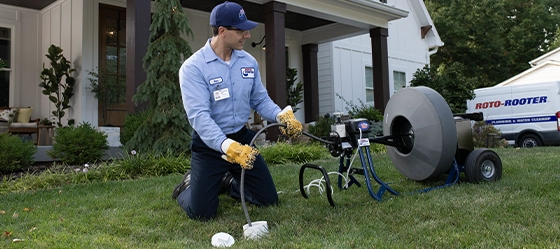
Almost everybody assumes their sewer line runs out to the street in front of the house. Across a great deal of St Louis that assumption is wrong, because the city was laid out with service alleys running behind the lots, and a building that backs onto one may well send its waste out the rear. That single fact rearranges the entire job before anyone discusses pipe.
Which Way Does My Sewer Line Actually Run?
A camera answers it in the same visit that diagnoses the fault, and the answer is not always what the household expects. The survey tracks the run from the cleanout outward, records the direction it takes, and puts a measured distance on every defect along the way. Knowing the line goes to the rear rather than the front changes where the machine parks, which surface comes up, and whether the work touches the front garden at all.
The findings themselves are the familiar ones and they do not care which way the pipe points. A collapsed section has no bore left to clean through. A severe offset leaves a lip that catches everything moving past it. A belly holds standing water, so solids settle and the run silts up again on a cycle. Roots through a broken joint are a structural finding rather than a blockage, because the opening will readmit them after cutting. Any of those four ends the cleaning conversation.
Where the Excavation Happens When the Main Is Behind You
A rear run changes the practical shape of an open cut completely. The trench crosses a back yard, a parking pad or a garage apron instead of a front lawn, and the equipment reaches it from the alley rather than from the street. Where that alley is narrow, poled and shared with neighbors, staging becomes part of the plan rather than an afterthought, and the crew works out access before a date is offered.
It also changes the trenchless conversation. Pipe bursting and lining both operate from access points at each end of the run, so a rear connection can be an advantage when there is somewhere to put a pit, and a serious obstacle where the far end abuts a garage slab, a fence line or a paved alley in constant use. Depth, the material and condition of the pipe, the degree of any collapse and that access all decide whether a trenchless method is available at all. It is a condition to be tested, not an upgrade to be bought.
Serving the entire Saint Louis metro area, Including:
Counties in the St Louis Metro Area
Marks Go Down Before Any Alley Paving Comes Up
A St Louis alley is one of the busiest strips of buried ground attached to a property. Gas, electric, water and telecom are frequently routed along it for a whole block, which makes utility locating more consequential here than in an open front yard, not less. Locates are requested and marked before an excavator touches anything, and nothing is opened until they are down. Anyone offering to trade that step for a day on the schedule is proposing to gamble with a gas line.
The job is permitted and inspected and Roto-Rooter handles that process as part of the work. There is no permit figure and no approval timeline on this page, because both vary by jurisdiction across the St Louis area and by the scope of the individual job, and a number published here turns into a promise nobody authorized. The on-site estimate settles it against the real work.
Who Owns the Line at the Back of the Lot?
The general division is unchanged by direction: the lateral from the building to the municipal main belongs to the property owner and the main belongs to the municipality. Where exactly that changes hands, at the property line, at the alley edge or at the connection itself, is set locally and differs between jurisdictions in Missouri as everywhere else. Confirm yours with your municipality rather than assuming, because it decides who pays for which length.
Roto-Rooter works the property owner's side of that boundary. Municipal main work is not something a plumbing company takes on, so when the footage points past the connection the next call is to the city rather than to a contractor.
Alley Paving, Rear Yards and What Gets Restored
Backfill and compaction are part of the work in Missouri as anywhere, and they matter more where the trench crosses something vehicles drive over. Spoil returned loosely will settle through the following seasons and leave a depression exactly where wheels track, which is why compaction in lifts on prepared bedding is worth asking about specifically rather than assuming.
On the surface, expect a straight answer. A cut across a rear yard shows for a season. A cut through a parking pad, an apron or alley paving is patched and remains visible afterward. Trenchless reduces it to access pits at each end where the line and the access permit. Final surface restoration, meaning turf, paving or hardscape, is scoped on site and written into the estimate rather than assumed either way, and where a shared surface is involved that scoping conversation happens before the work starts.
A Single Failure or a Long Run to the Rear?
Where the camera finds one failed joint or a single crushed length in a run that is otherwise sound, a spot repair opens that section alone and leaves the rest undisturbed. On a rear run that is a meaningful saving, because it may mean opening the yard without touching the alley at all.
What argues the other way is deterioration appearing the length of the pipe. When every joint on the footage shows the same separation, the age and material are the problem rather than a place along the run, and replacing one section leaves the others to fail on their own schedule. Ask how many defects the survey found and how far apart they sit, because that count is the difference between the two jobs.
What Happens If It Backs Up This Week
A line waiting on a scheduled replacement can still fail on any given evening. When it does, St Louis emergency plumbing help can restore flow so the household keeps functioning, on the understanding that clearing it is a holding action and changes nothing the camera found. For everything else handled locally, start with Roto-Rooter in St Louis.
Book a Camera Survey and Find Out Which Way It Runs
Direction, distance and defect all come out of the same visit, and all three belong in the decision before anybody prices a trench anywhere in St Louis. Call 314-925-2651 or schedule online to get the line on camera. Roto-Rooter provides on-site estimates before any work begins, so the scope and the footage reach you together and the choice is made from evidence. Roto-Rooter is fully licensed and insured, has worked on Missouri drain and sewer lines since 1935, and answers 24/7, 365 days a year, which is where the plumbing peace of mind comes from on a job of this size.

Brick Houses, Rear Alleys and Clay in Between
What the Camera Shows on a Run to the Rear

SPECIAL FINANCING AVAILABLE
We have partnered with Synchrony Bank to offer financing options to make your plumbing repair expenses as convenient and stress-free as possible.