Sewer and Water Line Excavation in San Jose
Key Takeaways: Why Excavation Follows a Line That Will Not Hold Fall
- A drain that clogs again a predictable number of months after every cleaning is not a cleaning problem. Something about the shape of the pipe is bringing it back.
- Gravity drainage depends on a steady, gentle fall the whole way out. Lose that anywhere along the run and solids settle at the low point instead of moving past it.
- A camera survey is what separates a pipe with material in it from a pipe that has moved. The two produce the same symptoms at the fixtures and need different work.
- Findings that close the argument: a collapse, a severe offset at a joint, a sag that holds standing water, and roots that have found their way in through a break.
- Pipe bursting and lining reduce the disruption where they are available, and depth, host-pipe condition and access at both ends decide whether they are.
- Utility locating precedes every dig without exception, covering gas, electric, water and telecom, and it is arranged before a crew is scheduled rather than on the day.
- Bedding is the quiet half of the job and counts for more in soft valley ground. New pipe set on graded, compacted material holds its fall; new pipe dropped into a rough trench starts settling again from the day it is covered.
- Roto-Rooter is fully licensed and insured, and permitting and inspection are handled as part of the work.
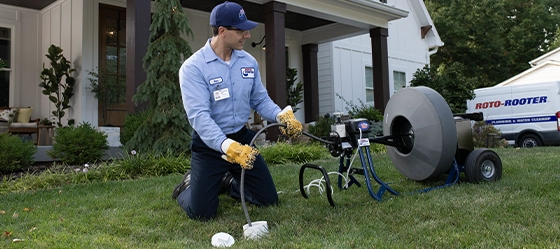
Ask what actually moves waste out of a house and the answer is not the pipe. It is the slope of the pipe. A sewer lateral has no pump behind it, so a steady fall of a fraction of an inch per foot is the entire mechanism, and anything that flattens part of the run turns that stretch into a settling basin. In San Jose the ground under those runs is deep, soft valley fill, which is exactly the sort of material that lets a heavy pipe find a slightly lower resting place over the decades.
The Difference Between a Blockage and a Line That Sags
Both feel identical from inside the house. Slow fixtures, gurgling, a backup at the lowest drain. The difference is what happens after the line is cleared. A genuine blockage, grease or a wipe or a root mass, clears and stays clear for a long time. A sag clears and then refills, because the water standing in the low spot never left and the next round of solids drops out in the same place.
That pattern is the useful diagnostic, and homeowners across San Jose usually have the data without realizing it. If cleanings are being scheduled at an interval you could mark on a calendar, the line is telling you it has a shape problem rather than a debris problem, and the camera is how you confirm it.
Is a Belly Something Cleaning Can Fix?
No, and that is worth saying plainly, because a great deal of money gets spent finding it out the slow way. Cleaning removes what is inside the pipe. A belly is the pipe itself sitting lower than the run either side of it, and no amount of cable or water pressure raises it. What cleaning buys is time, which is a legitimate thing to buy while a replacement is being scoped, but it is not a repair.
How much of the run comes out depends on how far the deflection extends. A single shallow low spot in an otherwise sound pipe can sometimes be corrected by opening that length and resetting it on proper bedding. A run that has settled unevenly along most of its length is a different conversation, and the footage is what tells the two apart.
Serving the entire San Jose metro area, Including:
Counties in the San Jose Area
Gas, Water and Fiber Under the Same Strip of Soil
Every buried service on a residential lot competes for the same shallow corridor between the building and the street, and a sewer lateral was usually there before most of the rest of it. Locating comes first: gas, electric, water and telecom are all marked, and no ground opens until they are. This is a safety and legal requirement in California, not a courtesy step that a schedule can absorb, and it is arranged ahead of the crew rather than on the morning of the dig.
The work is permitted and inspected, and Roto-Rooter carries that process as part of the job. What this page will not tell you is what a permit costs or how long an approval takes, because both are set locally and vary with the scope of the specific job. A number published here would turn into a promise nobody authorized. Your on-site estimate covers it against the actual work.
The Handover Point Nobody Agrees On
Broadly, the lateral out to the street is the property owner's and the main is the municipality's. The precise handover, whether it falls at the property line, at the curb, or at the connection to the main, is set by local rule and differs across the jurisdictions the San Jose franchise covers, so it is worth confirming with your municipality before assuming. It determines who pays, and it is the point where most misunderstandings on this kind of job start.
Roto-Rooter works on the property owner's side of that boundary. Municipal main work is not something a plumbing company undertakes, and if the inspection places the fault past the connection, the next call goes to the city.
Does Pipe Bursting Work in Soft Ground?
It can, and soft ground is one of the conditions that helps rather than hinders, because the displaced material has somewhere to go as the new pipe is drawn through. What rules it out is the state of the host pipe. Bursting needs a line whose path can still be followed and whose failure is not a full collapse, and lining needs a bore round enough and continuous enough to cure a new wall inside. Depth helps here too: with no frost line pushing laterals down, runs across San Jose sit shallower than they would in a cold-winter market, which keeps both the pits and an open cut smaller than the same job elsewhere.
There is a second consideration specific to a line that has lost its fall, and it deserves saying because it is the one people get wrong. A trenchless method follows the path of the existing pipe. If that path has sagged, the new line sags with it. Where the problem is grade rather than material, open-cut is the honest answer, because resetting the fall means putting the pipe somewhere the old pipe was not.
Bedding, Backfill and Grade After the Excavation
An open-cut trench disturbs the ground along its length, and where it crosses a driveway, a walk or a patio, that surface is opened. Trenchless shrinks the footprint substantially, though the entry and exit pits are still excavations and still land somewhere on the property. Be clear about which of those you are buying before the estimate is signed.
Underneath, the details that decide whether this repair is the last one are invisible the moment the trench closes. New pipe is set on graded, compacted bedding so the fall is uniform, and backfill is compacted in lifts rather than pushed in and left. Skipped compaction settles for months and leaves a depression along the trench line, and in ground as compressible as the San Jose valley floor it can pull the new run down with it. Final surface restoration, meaning turf, paving or hardscape, is scoped on site and agreed in advance rather than assumed.
Keeping the Kitchen Usable Until the Crew Comes
A line waiting on a replacement date rarely waits quietly. If it backs up before then, emergency plumbing in San Jose can restore flow so the household keeps functioning, with the understanding that it is a holding action rather than a fix. For everything else Roto-Rooter handles nearby, start at San Jose plumbers.
Call About a Line That Keeps Backing Up
Roto-Rooter has been solving drain and sewer problems since 1935, answers across California 24/7, 365 days a year, and is fully licensed and insured. Call 408-572-6300 or schedule online to get a camera down the line and find out whether you are dealing with debris or with grade. Roto-Rooter provides on-site estimates before any work begins, so the scope follows the footage. That is the plumbing peace of mind that matters on a repair this size.

Deep Alluvium, Orchard Ground and What Sits Under the Pipe
What the Camera Reads on a Valley-Floor Run

SPECIAL FINANCING AVAILABLE
We have partnered with Synchrony Bank to offer financing options to make your plumbing repair expenses as convenient and stress-free as possible.