Hydro Jetting in San Francisco
Key Takeaways: A Lateral That Carries the Rain as Well
- San Francisco runs a combined system, so on a great many properties the roof leaders and area drains feed the same lateral that carries waste out of the building.
- That means the pipe is holding leaf litter, roof grit and street debris on top of the grease, soap and paper every other line has to move.
- Hydro jetting scours the full circumference of the pipe wall and carries that mixture out, where a cable bores a channel through it and leaves the rest.
- The loading is seasonal rather than steady. Rain here arrives concentrated into a few winter months, so a run that coped all summer can fail in a week.
- A video camera inspection has to come first, to confirm the pipe can take high-pressure water and to find where the debris is collecting, then again afterward to prove the wall is clear.
- Mineral scale in old cast iron and tree roots at a clay seam are separate findings with separate answers, and descaling is a different task from clearing silt.
- A collapsed section, a badly offset joint or a wall thinned by corrosion rules cleaning out and starts a repair conversation instead.
- Roto-Rooter is fully licensed and insured and answers across San Francisco 24/7, 365 days a year.
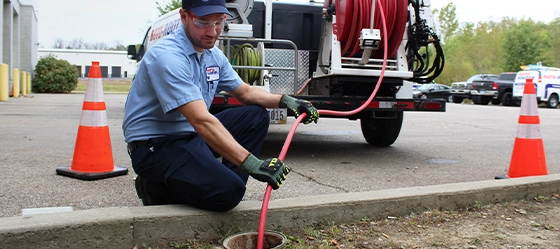
Most cities keep their storm water and their sewage in separate pipes. This one does not, and the consequence lands on a private lateral rather than on the utility. In a combined system the drain taking rain off a roof and the drain taking water out of a kitchen frequently end up in the same run, which means the pipe under a San Francisco sidewalk is carrying two very different kinds of material and only one of them came from inside the building.
One Pipe for the Sink and the Downspout
Household waste is predictable. Grease leaves a kitchen warm, cools, and sets along the crown of the pipe. Soap and paper collect on top of it. That story is the same everywhere and it is half of what is in the line here. The other half arrives from above: leaf litter off the parkway trees, grit washed off a roof, sand and fine sediment picked up on the way down a light well or a paved side passage.
The two work together in an unhelpful way. Fat gives fibrous debris something to stick to, and debris gives fat a rough surface to build on. A cable pushed into that mixture bores a passage through the middle, flow returns, and the mass stays wrapped around whatever caught it. The interval between calls shortens and nobody has taken anything out of the pipe.
What Hydro Jetting Takes Out of a Storm-Loaded Run
The hose is a different instrument. A nozzle throws water backward against the pipe wall while it is drawn along the run, so the scour covers the full circumference and the material is carried toward the main rather than compacted further along. Grease comes off the crown. Silt and leaf debris lying in a shallow stretch are flushed out. Mineral scale in older cast iron is cut back toward the original bore, which is the descaling half of the work. Root hair left at a seam after a cutter head is stripped with everything caught on it.
That is the difference between clearing a clog and cleaning a sewer line, and it is why Roto-Rooter treats end-to-end cleaning as the standard rather than an upgrade. Getting flow back is the emergency. Taking the wall back to bore is what gives a combined run the capacity it needs on the day the weather actually tests it.
Serving the entire San Francisco metro area, Including:
Counties in the San Francisco Metro Area
The Three Things That Send the Hose Back to the Truck
Cleaning assumes a pipe able to take it. A collapsed length has no bore left to recover. A joint badly offset, one section shifted out of line with the next, catches the hose and points at a structural fault that cleaning does not address. A wall worn thin by long corrosion may not survive the work, and in the original cast iron under older San Francisco buildings that is a real possibility rather than a form of words.
Any of those and the answer is a repair rather than a cleaning, scoped from the footage already recorded. On a narrow lot with neighbors on both sides, where along the run the fault sits matters a great deal to what a repair involves, which is another reason to look before anybody quotes. For the rest of what the local team handles, San Francisco plumbers is the place to start.
Commercial Kitchens Add Fat to a Run That Already Carries Grit
A restaurant line and a house lateral differ in diameter, in daily volume and in what a failure costs. A residential run that has been properly cleaned can go a long while before it needs attention again. A kitchen sending cooking waste down the same pipe through every service is working against a rate it cannot argue down, and where that pipe is also taking roof water it has less spare capacity to begin with. Food service operators across California generally put line cleaning on a calendar rather than waiting for the night it stops, and in this city the calendar usually has the storm season marked on it.
Should Hydro Jetting Happen Before the Rains or After?
Before, if the choice is yours. A combined lateral is at its most vulnerable when it is asked to carry a season's worth of roof water through a bore that has been narrowing all summer, so cleaning it while the weather is still dry is the cheap version of the same decision. After a wet winter is the other sensible moment, because that is when silt and leaf debris washed in during storms are sitting in the run and a camera can see exactly where they settled. What does not work is waiting for the failure, which arrives on the worst night of the year by definition.
If the line is backing up right now, start with emergency plumbing help in San Francisco. Restoring flow comes first and the cleaning decision follows.
What the Visit Looks Like on a Narrow Lot
A technician locates the cleanout, runs the camera and goes through the footage with you before any water goes in. If the run is a candidate, the hose is drawn through it and the wall is cleaned back toward its original diameter, then the camera repeats the trip so the difference is visible rather than claimed. Roto-Rooter provides on-site estimates before any work begins.
Access is the practical question here more than the work is. Buildings sit close together, side passages are narrow, and the cleanout may be in a light well, under a stair, or behind something that was built later. In a building of flats it is also worth agreeing in advance who is authorizing the work and telling the other households the line will be out of use for part of the visit. Where no usable cleanout exists, the inspection covers what adding one would take.
Schedule Line Cleaning Before the Rains in San Francisco
Roto-Rooter has cleaned drains and sewers since 1935 and is fully licensed and insured. Call 415-656-2130 or schedule online to find out how much capacity your lateral actually has before the weather asks for it. San Francisco crews answer 24/7, 365 days a year.

Signs the Run Is Carrying More Than Waste
Narrow Lots, Old Flats and a Winter That Arrives All at Once

SPECIAL FINANCING AVAILABLE
We have partnered with Synchrony Bank to offer financing options to make your plumbing repair expenses as convenient and stress-free as possible.