Hydro Jetting in Raleigh
Key Takeaways: A New Line Can Be Dirty Before Anyone Uses It
- A young drain that behaves like an old one usually has something in it that never came from a fixture: setting compound, grout slurry, joint compound, sand or clay fines that entered while the run was open.
- None of that dissolves and none of it floats, so water passes over it indefinitely and the deposit stays exactly where it landed.
- A cable can push a hole through a bed of grit and give you flow back for a while. It cannot lift the bed out, which is why the trouble returns on a pattern.
- Hydro jetting scours the full circumference of the pipe and carries the material out of the run rather than moving it along to the next low point.
- A video camera inspection comes first. It shows whether the problem is debris, grease, scale or tree roots, and those are four different conversations.
- Raleigh has been building and remodeling at pace for a long time, and a sewer line in Raleigh can be young in years and still carry a lifetime of somebody's mortar.
- One slow fixture is not this job. That is Raleigh drain cleaning, and it is a shorter visit.
- Roto-Rooter is fully licensed and insured and answers 24/7, 365 days a year.
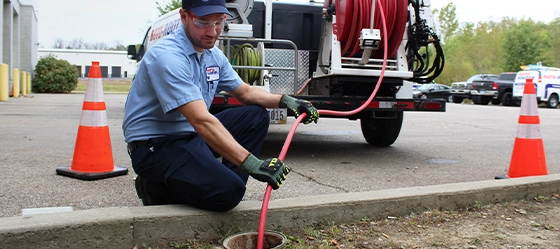
An open pipe stub on a job site is a hole in the floor, and holes in floors collect things. That is the unglamorous explanation behind a surprising share of drain problems in newer houses and freshly renovated ones across Raleigh, and it is worth stating plainly because it points at a different fix than a clog does.
What a Build-Out Leaves in a Drain
Tile work rinses setting compound and grout down whatever is nearest. Drywall finishing produces a slurry that sets soft and then hardens. Sand, sawdust, plastic shavings from cutting pipe, and the fine red clay that gets tracked through every site in the North Carolina Piedmont all end up in the same place. Nobody intends it and it happens on careful jobs as well as careless ones.
What matters is the behavior afterward. Organic waste breaks down. Mineral and cementitious material does not, and it is heavier than water, so it settles at the first point in the run where the flow slows and then simply stays. Every solid arriving later meets that shelf and some of it stops too. A house occupied for two years can present with a line that acts like it has been in service for thirty.
Can Hydro Jetting Clear Setting Compound and Grit?
Yes, and that is largely what it is for. A hose carries a nozzle that drives high-pressure water backward against the pipe wall as it is drawn along the sewer line, so the working surface is the whole circumference rather than the middle of the channel. A bed of grit is lifted and carried out with the flow instead of being bored through. Hardened grease comes off the crown the same way. Where older cast iron has corroded inward, descaling cuts the deposit back toward the bore the pipe was made with, and root hair left after a cutting head is stripped off the joint that let it in.
The limit is honest and worth knowing up front. Material that has genuinely set into a solid mass in a section of pipe may not come out at all, and if a camera shows that, the conversation turns to replacing a length rather than cleaning it. Better to learn that from footage than from three visits.
Serving the entire Raleigh metro area, Including:
Counties in the Raleigh Metro Area
What Hydro Jetting Cannot Undo
Pressure cleans and it assumes a sound pipe underneath. Three findings end the discussion. A collapsed section has no bore left to recover. A joint offset far enough that one length no longer meets the next will catch a hose, and the misalignment is the actual fault. A wall thinned by long corrosion may not survive the work, and the inspection is what establishes that in advance rather than afterward.
There is a fourth on newer lines specifically, and it belongs here. A pipe left bearing on a rock or crossing fill that has settled unevenly can hold a low spot no amount of cleaning will remove. Jetting empties it and the low spot remains, so it fills again. That is not a failure of the method, it is the method being asked to fix geometry, and the camera footage is what tells you which of the two you are looking at.
Restaurant Fit-Outs Load a Line Twice
Commercial runs are larger in diameter and heavier in daily loading than house lines, and a kitchen fit-out is unusual in that it delivers both problems at once: a quantity of construction material into the run, followed immediately by full service volume on top of it. That combination is why an operator in Raleigh who cleans the line once after opening and then sets an interval from what the camera finds tends to have a far quieter first couple of years than one who waits.
Roto-Rooter covers both sides. For everything else a property here needs, start with Roto-Rooter plumbing in Raleigh.
Where the Cleanout Ends Up After a Renovation
A visit starts at the cleanout. The technician finds it, runs the camera and talks through what is on the screen before any decision is made. If the line is a candidate, the hose goes in, the affected stretch is cleaned, and the camera goes back down so the wall can be seen rather than described. Roto-Rooter provides on-site estimates before any work begins.
Renovations are hard on access points. Cleanouts get decked over, planted around, paved across and occasionally buried during a landscaping job that had nothing to do with plumbing. Mentioning it on the phone saves time once a truck is on the street, and around Raleigh a deck or a patio added since the build is the usual culprit. Where no cleanout exists, the inspection covers what adding one to North Carolina plumbing code would take, and on a line that has needed help once it is generally worth it.
What the Footage Is Worth Later
The immediate result is bore. A pipe cleaned back to the wall carries what it was sized to carry, so the slow drain, the gurgle and the fixture that backs up when the washer empties tend to clear together rather than one at a time. The lasting result is a recording of your own line in known condition. On a young house that record is unusually useful, because it separates what the builder left from what the household has since added, and an owner in Raleigh holding it is not starting the argument from nothing.
If a line is backing up right now, cleaning is tomorrow's conversation. Start with emergency plumbing help in Raleigh and get the flow back first.
Book a Line Inspection in Raleigh
Roto-Rooter has been clearing and cleaning drains since 1935, and is fully licensed and insured. Call 919-546-8689 or schedule online to find out what is actually sitting in the run before it becomes an evening emergency, and get the plumbing peace of mind that comes with seeing it. Roto-Rooter answers 24/7, 365 days a year.

What a New Line Can Already Be Carrying
Building Quickly on Piedmont Clay

SPECIAL FINANCING AVAILABLE
We have partnered with Synchrony Bank to offer financing options to make your plumbing repair expenses as convenient and stress-free as possible.