Hydro Jetting in Providence
Key Takeaways: What a Pipe Laid Partly on Rock Does Over Time
- A line that blocks in the same place every time is reporting a condition at that place, not a habit in the kitchen.
- Ground here is shallow soil over ledge with stony glacial till in between, so a trench gives a pipe hard support in one stretch and soft support in the next.
- Support that changes along a run is what puts a lip at a joint or a hairline crack over a high point, and both catch solids and admit roots.
- Hydro jetting scours the full circumference of the pipe with high-pressure water, so what has collected at that point leaves the line rather than being bored through.
- A video camera inspection comes first, because a fixed blockage location is a clue that has to be looked at rather than assumed.
- Grease, mineral scale in older cast iron, and root hair left after a cutter head are three different findings, and the footage is what separates them.
- Some lines are past cleaning. A collapsed length, a joint that has gone badly out of line, or a wall thinned by long corrosion needs a repair conversation instead of a hose, and opening ground in Rhode Island is not a small undertaking.
- Roto-Rooter is fully licensed and insured, and answers in Providence 24/7, 365 days a year.
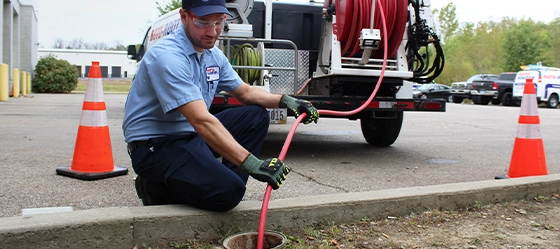
Ask a technician who has worked this city for a while where the blockages are and you will get an answer about locations rather than about causes. The same run closes at the same footage mark, year after year, and it does not much matter what the household changes upstairs. That pattern is worth taking seriously, because a blockage with a fixed address is telling you about the pipe rather than about what went into it.
The reason usually starts with the trench. Ground across Providence is shallow soil over ledge, with glacial till in between that is more stone than dirt. A crew laying a lateral through that does not get to choose a uniform bed. Part of the run ends up carried on rock that will never move again, part on soil that will settle for decades, and the backfill going back over the top is the same stony material with cobbles in it. A pipe supported that unevenly takes the strain somewhere, and it takes it at the weakest thing available, which is a joint.
Why Blockages Here Repeat at One Spot
Two things happen at a place where support changes. The first is a lip: one length settles a fraction while the next does not, and the small step left between them catches paper and solids the way a raised nail catches a sleeve. The second is a crack, where a stone in the backfill bears on the crown of the pipe and eventually wins. A crack is an opening, and an opening under a Rhode Island yard will be found by tree roots.
Either way the run now has a collecting point. Material stops there, builds outward from it, and closes the pipe. A cable sent down bores a channel through the accumulation, flow returns, and the collecting point is entirely unchanged, which is why the same call comes in again on roughly the same schedule. Providence technicians see that pattern more than most.
What Hydro Jetting Clears at a Lipped Joint
A jetting hose carries a nozzle that directs high-pressure water backward against the pipe wall while the hose is drawn through the run. The scour covers the whole circumference rather than a hole through the middle of the obstruction, and because the jets face behind the nozzle they drive what they lift toward the main instead of packing it further in. At a collecting point, that means the accumulation is carried out rather than perforated. Along the rest of the run the same pass takes grease off the crown, flushes sludge from any flat stretch, cuts mineral scale in older cast iron back toward the original bore, which is the descaling half of the work, and strips root hair left in a joint after a cutter head.
That end-to-end difference is the whole argument for the method, and it is why Roto-Rooter treats cleaning the pipe back to the wall as the standard rather than an upgrade. What jetting does not do is remove the lip or close the crack. It empties the trap the pipe has made for itself, which is a real and durable improvement, and the footage then tells you whether the feature underneath is worth repairing. On Rhode Island ground that is a decision worth taking slowly.
Serving the entire Providence metro area, Including:
Counties in the Providence Metro Area
The Line That Has Moved Too Far to Clean
A collecting point is worth cleaning. A run that has moved past being a collecting point is not, and three findings mark the boundary. A section that has broken up offers no bore to restore. A joint displaced far enough to leave a real step will catch a hose rather than pass it, and on ground this uneven that is the common one. A wall corroded thin may not take pressure. Establishing which of those is present before anybody talks about digging matters more on a Providence lot than it does on soft ground.
On uneven ground the second of those is the common one. A small step at a joint is a collecting point and cleaning helps a great deal. A large one is a different category, and a hose will not improve it. High-pressure water cleans a pipe; it does not restore one, and a technician who has watched the footage will say which of the two you have rather than sell the visit anyway.
Can Hydro Jetting Fix a Cracked or Lipped Joint?
No, and it is worth being direct about that. Cleaning removes what has collected at a defect and gives the run its bore back, which is why a line that had been closing every few months can go quiet for years afterward. The defect itself is untouched. What changes is that you now know it is there, how big it is, and how far along the run it sits.
That is genuinely useful information rather than a consolation. A modest lip with no root intrusion is something a household can manage on a cleaning interval indefinitely. A separated joint taking roots on stony ground is a case for a repair conversation, and knowing which one you have before the ground is opened is worth more here than in most places, because Rhode Island ground does not open cheaply.
Kitchens and Commercial Runs on the Same Ground
A house lateral and a commercial kitchen run carry different diameters, different daily loads, and very different consequences when they close. A cleaned residential line in Providence can go years before it needs attention again, depending on what fouled it and on whether there is a collecting point feeding the problem. A kitchen putting cooking waste through the same pipe every service is working against a known accumulation rate, which is why food service operators across Rhode Island settle on a planned interval instead of waiting for a failure during a dinner rush.
Roto-Rooter handles both. For the wider set of plumbing work across a property, the Providence plumbers page is the place to start.
What Reaching the Line Involves Here
A technician locates the cleanout, runs the camera, and talks through what is on the screen before anything else happens. If the run is a candidate, the hose goes in, the pipe is cleaned back through the affected stretch, and the camera goes down a second time so the wall can be seen rather than described. Roto-Rooter provides on-site estimates before any work begins, so nothing proceeds until the scope has been agreed.
Access is the practical variable on the tight lots common across older Providence neighborhoods. A cleanout in a reachable spot makes for a straightforward appointment, while one paved over, built around during a renovation, or never fitted at all changes the approach, and it is worth raising when you call rather than discovering on the day. If a line is actively backing up rather than slowly closing, start with emergency plumbing help in Providence, because restoring flow comes first and the cleaning conversation follows.
Book a Camera Inspection and Cleaning in Providence
Roto-Rooter has been cleaning sewer lines since 1935 and is fully licensed and insured. Call 401-228-1063 or schedule online to have the line looked at and cleaned, and get the plumbing peace of mind that comes from knowing exactly where the trouble sits anywhere in the Providence area. Roto-Rooter answers 24/7, 365 days a year.

Findings That Point at a Fixed Location
Shallow Soil, Stony Till and a Trench That Hits Rock

SPECIAL FINANCING AVAILABLE
We have partnered with Synchrony Bank to offer financing options to make your plumbing repair expenses as convenient and stress-free as possible.