Sewer and Water Line Excavation in Portland
Key Takeaways: The Surface Over the Line Is Growing
- On a planted Portland lot the trench does not cross bare ground. It crosses beds, shrubs, edging and things somebody has spent years establishing, and that is worth planning for rather than discovering.
- Anything worth saving comes out before the excavation opens, not afterward. Once a machine or a spoil pile is on top of a bed, the decision has already been made for you.
- Knowing the route in advance is what makes that possible, and the camera reads distance as it travels so the line can be marked on the surface before anybody lifts anything.
- Four findings end the cleaning conversation: a collapse, a joint out of alignment, a length holding standing water, and roots entering through a break.
- Trenchless methods are conditional on depth, material, degree of collapse and access at both ends, and where they are available they are the strongest argument available for a garden.
- Utility locating precedes any Portland excavation and is a legal and safety obligation rather than a gardening consideration.
- Where the private lateral ends and the public main begins is set locally, so the boundary is a question for your municipality rather than an assumption.
- Roto-Rooter is fully licensed and insured, handles the permit and inspection process, and provides on-site estimates before any work begins.
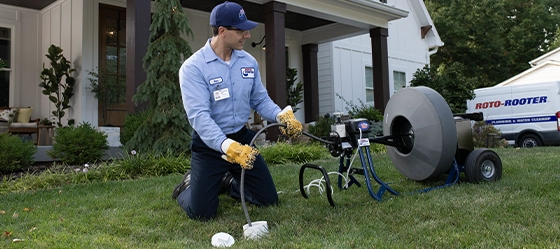
Turf forgives an excavation. A garden does not. On a great many Portland lots the ground a sewer trench has to cross carries established planting rather than lawn, and the difference matters, because turf goes back in an afternoon and a hedge somebody has been growing for fifteen seasons does not go back at all. That is not a reason to avoid the work. It is a reason to know the route before the first cut.
Establishing the Route Under the Planting
Symptoms will not tell you where to dig or whether to dig. Repeat backups, several fixtures slowing at once and wet ground appearing over the route all say the main run leaving the building is involved, without saying whether it is obstructed or broken. A camera survey settles that, and it does something a Portland gardener should care about equally: it reads distance as it travels, so the position of the defect and the path of the run can be put on the surface before anything is moved.
Four findings take a run out of the cleaning category. A collapsed length has no bore left to restore. A joint that has stepped out of alignment leaves a lip catching solids on every discharge. A sag holds standing water, so the line reloads whatever cleaning is done. Roots entering through a break are attached to an opening that will keep admitting them in a climate with a very long growing season.
Which Method Opens Less Ground
An open cut trenches along the run, lifts the failed pipe, lays the new one, then backfills and compacts. It works on any condition of pipe, and on a planted lot it is the method whose footprint has to be planned around most carefully, because the trench and its working room take a continuous strip rather than a couple of holes.
Pipe bursting draws a new line along the old path from access pits at each end, and lining cures a new wall inside the existing pipe. Both leave the ground between the pits largely undisturbed, which on an established Portland garden is the difference between losing a strip and losing two patches. Neither is universally available: depth, pipe material, the degree of any collapse and usable access at both ends decide, and all four come off the footage rather than off how much anybody likes the planting.
Serving the entire Portland metro area, Including:
Counties in the Portland Metro Area
What Can Be Saved and What Cannot
The straight version is this. Small planting, divisions and anything in a container can be lifted, held and put back, and the wet half of the year is kinder to that than the dry half. Established shrubs with a substantial root plate can sometimes be moved and frequently cannot, and a hedge that runs along the trench line is usually a loss rather than a relocation. Mature trees are a separate conversation and a specialist one.
What Roto-Rooter can commit to is the part of it that belongs to a plumbing company: the route marked before anything is disturbed, the method chosen off the footage rather than out of habit, the trench kept to what the work requires, and the ground put back properly. What happens to the planting afterward is scoped on the property and agreed in advance rather than assumed, and where the honest answer is that something will not survive, it is better said before the machine arrives.
Locating Before Any Bed Is Disturbed
Gas, electric, water and telecom are located and marked before any Portland excavation begins. This is a legal and safety obligation and it is not a substitute for the other conversation: a public locate covers utility-owned services and does not mark the irrigation, lighting or garden work you installed yourself. Tell the crew about those, and nothing opens until the marks are down.
The Permit Is Handled, the Weather Is Not
The work is permitted and inspected across Oregon, and Roto-Rooter carries that process as part of the job. What this page will not state is a permit fee or an approval timeline, because both vary by jurisdiction and by the scope of the specific job, and a number published here becomes a promise nobody authorized. The same applies to duration: ground conditions decide more of that than a schedule does, particularly in a market with a long wet season. Your on-site estimate covers scope against the actual work.
The Public End of the Run
The line from the building to the public main is generally the property owner's, and the main is generally the municipality's. Where that boundary falls, at the property line, at the curb or at the connection, is set locally and varies. Confirm it with your municipality rather than assuming, because it decides who pays for which length of pipe, and it also decides how much of your own ground is actually involved.
Roto-Rooter works on the property owner's side of that boundary. Municipal main work is not something a plumbing company undertakes, so a finding past the connection sends the next call to the city.
Backfill, Compaction and Replanting
Backfill and compaction are part of the work, and they matter to a garden for a reason beyond tidiness: ground that settles takes whatever was replanted on top of it down with it, and a bed that sinks along a trench line collects water in a Portland winter. Properly placed and compacted fill is the foundation the replanting depends on, which is why it is worth asking about rather than assuming.
Final surface restoration, meaning turf, planting beds, paving or hardscape, is scoped on the property and agreed before work starts rather than assumed either way. Trenchless reduces the footprint substantially where the line supports it, though the access pits at each end are still excavations and still land somewhere.
While the Work Waits for a Workable Window
A failing run does not schedule itself around the weather or the season. If it backs up while the work is being arranged, emergency plumbing help in Portland can restore flow so the household keeps working, which is a holding action rather than a repair and changes nothing the camera found. For everything else handled locally, start at the Portland service page.
Schedule the Survey and Mark the Route First
Roto-Rooter has served Oregon property owners since 1935 and is fully licensed and insured. Call 503-937-1993 or schedule online to have the line filmed and its path established on the ground. Roto-Rooter provides on-site estimates before any work begins, so what the trench will cross is known before anything is lifted. On a yard somebody has spent years building, that is the plumbing peace of mind worth having, and Roto-Rooter answers 24/7, 365 days a year.

What to Lift Before the Trench Opens
A Long Wet Season and a Yard That Barely Stops Growing

SPECIAL FINANCING AVAILABLE
We have partnered with Synchrony Bank to offer financing options to make your plumbing repair expenses as convenient and stress-free as possible.