Sewer and Water Line Excavation in Phoenix
Key Takeaways: What You Still Have After the Trench Is Closed
- A buried repair disappears the moment it is backfilled, so the lasting part of the job is the record it leaves: where the run goes, how deep, what it is made of now, and what the camera saw on the way out.
- Every scope starts with footage. A camera goes down a Phoenix line before anybody proposes a dig, because a blocked pipe and a failed pipe look the same from indoors and lead to entirely different work.
- Four findings rule out cleaning for good: a collapse, a joint shifted out of alignment, a length that sags and holds water, and roots entering through a break.
- Trenchless is conditional and never an upgrade tier. Depth, material, how far the run has gone and whether both ends offer access decide whether it is even on the table.
- Utility locating precedes any excavation in Phoenix and is not optional. Gas, electric, water and telecom all get marked first.
- An accessible cleanout is the cheapest thing to add while the ground is already open, and a property without one pays for that on every future visit.
- Where a private lateral ends and the public main begins varies by jurisdiction, so the boundary is a question for your municipality rather than something to assume.
- Roto-Rooter is fully licensed and insured, handles the permit and inspection process, and the inspection is an independent check on work nobody can see once it is covered.
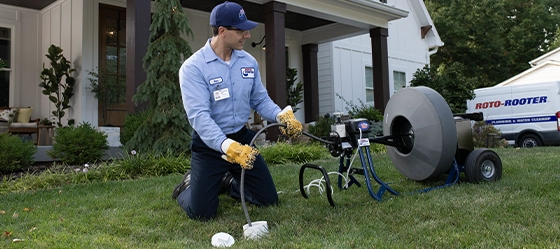
Everything about a sewer excavation is verifiable while the trench is open and invisible an hour after it closes. That is the awkward fact at the heart of this service, and it is why a Phoenix property owner should care about paperwork on a job that seems to be entirely about dirt. Whoever opens this ground next, whether that is in a decade or on the day the house sells, will work from whatever record exists. If none exists, they start where you started.
Evidence Before Excavation
The first record on the file is the survey that justified the work. Recurring backups, several fixtures draining slowly at once, and water surfacing over the line all point at the run leaving the building, and none of them explains itself. A camera pass answers the question by showing whether the bore is obstructed or the pipe has failed, and a continuous recording with distances called out is worth considerably more later than a still frame of the worst spot.
Four findings take a Phoenix line out of the cleaning category. A collapsed section has no bore left to work with. A joint that has shifted leaves a permanent lip that catches whatever passes it. A length that has sagged holds standing water, so solids settle there and the run reloads on a schedule no cleaning changes. Roots entering through a break are the growth you can see attached to an opening that will keep admitting them.
Which Method the Line Will Actually Support
An open cut on a Phoenix property takes the trench along the run, lifts the old pipe out, lays the new one, then backfills and compacts. It handles any condition and it disturbs whatever is above the line. Pipe bursting pulls a new line through the path of the old one from access pits at each end, and lining cures a new wall inside the existing pipe. Both trenchless methods leave far less surface disturbed.
Neither is universally available, and in Arizona ground the reason is frequently underfoot. A burst head has to displace soil outward as it travels, which asks something of the material around the pipe, and a lining needs a continuous host with enough shape left to cure against. Depth, pipe material, the degree of any collapse and usable access at both ends decide it, and all four come off the footage rather than off a preference.
Serving the entire Phoenix metro area, Including:
Counties in the Phoenix Area
The Cleanout the Property Did Not Have
Plenty of Phoenix properties have no accessible cleanout on the sewer lateral, which means every visit for the rest of the building's life starts by finding a way in. While the ground is open and the pipe is exposed, adding one is a small piece of a large job. Afterwards it is a separate excavation with its own scope. This is the clearest example of the whole argument here: the moment to buy the next twenty years of easy access is the moment the trench is already dug.
The same logic covers the after-camera pass. Running the camera back through the finished line, with the distances logged, records that the new run is clear, correctly laid and connected, and it gives the property a baseline that any later footage can be read against. Ask for it, and ask for a copy.
Marking Comes Before Digging, Every Time
Nothing on a Phoenix property gets opened until gas, electric, water and telecom have been located and marked. This is a legal and safety obligation rather than a professional courtesy, and it is not something a crew trades away to gain a morning. The marks are also worth photographing before they fade, because they are a free snapshot of what else is buried near the run.
A Permit File Somebody Can Find Later
Work of this kind in Phoenix is permitted and inspected, and Roto-Rooter handles that process as part of the job. Deliberately absent from this page is what a permit costs or how long an approval takes, because both vary by jurisdiction and by scope, and a number published here becomes a promise nobody authorized. Your on-site estimate covers it against the actual work. What the permit leaves behind matters as much as what it allows: an inspection is an independent check on a repair that nobody will ever see again, and the record of it belongs with the property.
The One Boundary No Record Can Settle
The line running from the building to the public main is generally the owner's, and the main is generally the municipality's. Where exactly the responsibility changes, at the property line, at the curb or at the connection, is set locally and varies between jurisdictions across Arizona. Confirm it rather than assume it, because it decides who pays for which length of pipe.
Roto-Rooter works on the property owner's side of that boundary. Municipal main work is not something a plumbing company undertakes, so a finding past the connection sends the next call to the city instead of to a contractor.
Backfill, Compaction and a Surface That Shows Everything
An open cut across a Phoenix lot disturbs ground along its full length, and where the run passes under a driveway, a walk or a patio, that surface has to come up. Trenchless reduces the footprint a great deal, which is why it is worth asking about, though the access pits at each end are still excavations. Backfill and compaction are part of the work, and compaction is what stops the trench line from settling into a visible depression over the following months.
Final surface restoration, meaning turf, gravel, paving or hardscape, is scoped on the property and agreed before work starts rather than assumed either way. Get that boundary written down. On a rock or concrete surface it is the single most common source of disappointment on an otherwise sound Arizona job.
If the Line Gives Out Before the Crew Arrives
A run bad enough to justify replacement does not wait for the appointment. If it backs up first, emergency plumbing help in Phoenix can restore flow so the property keeps working. That is a holding action and it changes nothing the camera found. For everything else Roto-Rooter handles locally, start at the Phoenix service page.
Start With a Camera Survey and Keep the Footage
Roto-Rooter has served Arizona property owners since 1935 and is fully licensed and insured. Call 623-915-0995 or schedule online to put a camera down the line. Roto-Rooter provides on-site estimates before any work begins, so the scope arrives with the evidence attached rather than ahead of it. On a repair that gets buried the day it is finished, documentation is the plumbing peace of mind worth paying attention to, and Roto-Rooter answers 24/7, 365 days a year.

What a Camera Pass Puts on Record
Cemented Ground and a Surface That Never Grows Back Over

SPECIAL FINANCING AVAILABLE
We have partnered with Synchrony Bank to offer financing options to make your plumbing repair expenses as convenient and stress-free as possible.