Hydro Jetting in Orlando
Key Takeaways: What a City That Never Closes Puts in a Sewer Line
- Fat leaves a sink warm and liquid, cools a few feet into the sewer line, and sets along the crown of the pipe where it is hardest to reach.
- Hydro jetting cleans the full circumference back to the pipe wall, which is why a greased line answers to it and does not answer to a cable.
- A cable bores an opening through the blockage and leaves the coating in place, so the line closes again on the same schedule that produced the first backup.
- A kitchen that serves every week of the year fouls its run at a rate that can be measured, and a planned interval beats a Saturday night failure.
- A video camera inspection goes first, both to find the cause and to confirm the pipe can take pressure, and goes back down afterward to show the wall is clear.
- Grease, mineral scale inside older cast iron, and root hair left behind by a cutter head are separate problems with separate answers.
- A collapsed or badly offset pipe is not a jetting candidate, and cleaning one is not an honest recommendation.
- Roto-Rooter is fully licensed and insured, and works in Orlando 24/7, 365 days a year.
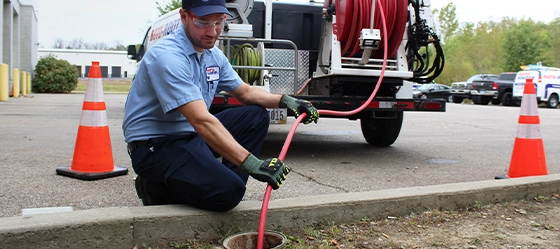
Grease leaves a kitchen as a liquid and arrives downstream as something closer to wax. That single change of state is behind most of the calls this page answers. Warm water carries fat past the trap and a few feet along the run, the pipe is cooler than the water, and the fat comes out of suspension onto the wall. Each service adds a layer. Nothing dramatic happens for a long time, and then the run closes on a night when there is no good time for it to close.
A Year With No Slow Season
Most cities give a kitchen a quiet stretch. Orlando does not. Hotel restaurants, banquet kitchens, the food halls around the attractions corridor and the ordinary neighborhood places that feed the people who staff all of it run at volume through every month of the calendar. A line under a building like that is not accumulating buildup in bursts, it is accumulating steadily, which is actually the easier problem to manage because a steady rate can be planned against.
The same is true in a smaller way for houses in Orlando, where a large share of the stock was built after the region grew into a metropolitan area and runs plastic waste lines to a lateral that has been in the ground for decades. The material at the house is smooth. The material out at the property line is what needs reading.
Cutting Through Grease Against Taking It Off the Wall
A cable is a boring tool. It punches a channel through a blockage and restores flow, which is exactly what is wanted at nine in the evening with a dining room full. What it cannot do is take the hardened layer off the pipe wall on either side of that channel. Hydro jetting is the other approach: a nozzle carried on a hose throws high-pressure water backward against the wall as the hose is drawn through, and the cleaning is a scour across the whole circumference rather than a hole through the middle. Grease comes off. Sludge in a low-slope run flushes back toward the access point. Mineral scale in older cast iron is cut toward the original bore, which is the descaling side of the work, and root hair left at a joint after a cutter head is stripped away.
Clearing a clog and cleaning a pipe are two different pieces of work. Only the second one changes what the line does next quarter.
Serving the entire Orlando metro area, Including:
Counties in the Orlando Metro Area
When a Line Is Past Cleaning
Everything above assumes a pipe in one piece. Three findings take jetting off the table. A collapsed section has no bore left to work with. A joint that has shifted badly out of line will catch the hose, and what is wrong there is structural rather than dirty. A wall already thinned by long corrosion may not survive pressure, and the inspection is what shows that in advance. Jetting cleans a pipe. It does not repair one, and no amount of pressure turns a broken line into a working line.
Where the camera finds one of those, the recommendation changes to a repair conversation and the footage becomes the starting point for it. For an Orlando restaurant that cannot close, the sequence and the timing of that work matter as much as the work itself, and both get discussed before anything is scheduled.
How Often Does a Busy Kitchen Line Need Jetting?
There is no interval that fits every kitchen, and any company quoting one before it has seen the line is guessing. Volume, menu, how much fat goes down an Orlando drain rather than into a container, the diameter of the run and how much fall it has all move the number. What experienced operators in Orlando do is start from the condition found on the first camera pass, set a schedule from there, then tighten or relax it once they have watched the line for a year. That is a maintenance interval built on evidence rather than on a sales sheet.
Houses Have the Same Problem in Slow Motion
A residential lateral is smaller in diameter and carries a fraction of the load, so the same process takes years instead of months. The symptoms differ too: a house tends to announce the problem through a slow tub or a gurgle when the washing machine drains, while a commercial run announces it by backing up into a floor drain during service. In the warm ground of central Florida neither version improves on its own. A residential line in Orlando that has been cleaned to the wall can go a long stretch before it needs attention, and what decides the stretch is what caused the buildup in the first place.
For everything else a property here might need, the Orlando plumbers page is the better starting point.
What the Before and After Are Actually For
The camera before the hose answers two questions: what is in the pipe, and whether the pipe can take the work. The camera after it answers a third, which is whether the wall is clean rather than merely open. That last one is the difference between paying for a result and paying for a visit, and it is worth asking any company to show you. On a commercial line it also produces the record that a manager can put in front of a landlord or an inspector.
If a line is backing up right now instead of slowly getting worse, start with emergency plumbing help in Orlando. Flow first, cleaning second.
Getting to the Line Behind a Busy Building
Access decides how long a visit takes. A cleanout in the open behind a building makes for straightforward work. One buried under a rebuilt patio, paved over during a parking expansion, or never installed at all changes the approach, and it is worth saying so on the phone rather than discovering it with a truck on site. Plenty of older houses in Orlando have no exterior cleanout either, and where none exists the inspection covers what putting one in would involve. On a commercial property in Florida it is also worth knowing when the interceptor was last pumped, because a full one changes what the line downstream has been carrying.
Book Hydro Jetting for an Orlando Kitchen or Home
Roto-Rooter has been in business since 1935, is fully licensed and insured, and answers in Orlando 24/7, 365 days a year. Call 407-886-7311 or schedule online to get a camera in the line and a plan that fits the way the building actually runs anywhere in Orlando. On-site estimates come before any work begins, which is where the plumbing peace of mind starts for most operators.

Where Grease Collects, and What It Does There
A Region That Serves Meals Every Week of the Year

SPECIAL FINANCING AVAILABLE
We have partnered with Synchrony Bank to offer financing options to make your plumbing repair expenses as convenient and stress-free as possible.