Hydro Jetting in Orange County
Key Takeaways: A Drain Line You Cannot Reach From Above or Below
- Under slab-on-grade construction the waste line is cast into the ground beneath poured concrete, so there is no crawl space to open and no floor above it to lift.
- That makes the cleanout the only practical way in, and it makes the condition of the pipe worth knowing well before anything fails.
- Hydro jetting cleans the full circumference of the pipe wall through that single access point, where a cable bores a channel through the blockage and leaves the coating in place.
- Grease from a kitchen, soap and paper, sludge in a shallow stretch and mineral scale in older cast iron are all removable. Structural faults are not.
- A video camera inspection has to come first, because on an under-slab run the difference between a dirty pipe and a damaged one is the difference between an afternoon and a demolition.
- Tree roots at a seam are the common complication across older Orange County tracts, where mature street trees have had decades to find a weeping joint.
- A collapsed section, a badly offset joint or a wall thinned by corrosion rules cleaning out, and descaling a fragile pipe helps nobody.
- Roto-Rooter is fully licensed and insured and answers across Orange County 24/7, 365 days a year.
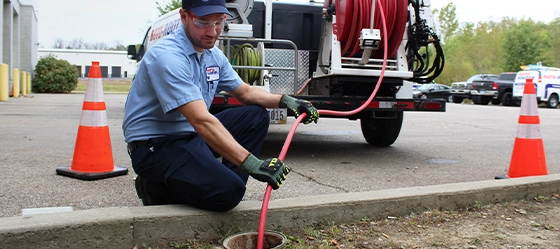
Concrete changes the whole conversation. In a slab-built Orange County home the drain line was laid in a trench, inspected, and then buried under a poured floor that the rest of the building sits on. From that moment the pipe has exactly one door: the cleanout. Everything anybody will ever learn about that run, and everything anybody will ever do to it short of demolition, comes through that opening.
Out of Sight, and Genuinely Out of Reach
The practical consequence is that nobody inspects an under-slab line casually. It gets attention when a fixture slows or a floor drain backs up, and by then the run has usually been narrowing for years. Grease from the kitchen sets along the crown, soap and paper collect on top of it, and the effective diameter drops without a single visible symptom until two fixtures start interfering with each other.
A cable is sent down and it works. It bores an opening through whatever has collected, water goes down, and the household gets on with its week. The coating on the pipe wall is untouched, so the opening closes again at whatever rate it formed. The problem specific to slab construction is that this cycle can run for years without anyone forming an opinion about the pipe itself, because nobody has ever seen it.
Why Hydro Jetting Suits a Line Under Concrete
High-pressure water reaches everything the access point connects to. A nozzle throws water backward against the pipe wall while the hose is drawn along the run, so the scour covers the full circumference rather than the middle, all the way out. Hardened grease comes off the crown. Sludge lying in a shallow stretch is carried out toward the main instead of pushed along. Mineral scale in old cast iron is cut back toward the original bore, which is the descaling half of the work. Root hair left at a seam after a cutter head is stripped along with everything caught on it.
That is the difference between clearing a clog and cleaning a sewer line, and it is why Roto-Rooter treats end-to-end cleaning as the standard rather than an upgrade. In a market where the alternative involves a saw and a floor, getting the maximum life out of sound pipe is not an upsell. It is the sensible order of operations.
Serving Orange County and surrounding communities, Including:
Counties in the Orange County Area
When Breaking Concrete Is the Only Honest Answer
Cleaning assumes a pipe that can be cleaned. Three findings end it. A collapsed length has no bore left to recover. A joint badly offset, one section shifted out of line with the next, catches the hose and points at a structural fault that no amount of cleaning addresses. A wall worn thin by long corrosion may not survive the work.
Any of those and the answer is a repair rather than a cleaning, and under a slab that means either opening the floor above the fault or a trenchless approach worked through the existing access. Which one applies depends on where the fault sits and what the pipe is made of, and both of those come off the footage the camera already recorded. Nobody should be cutting concrete on a guess. For the rest of what the local team handles, Orange County plumbers is the place to start.
Strip Centers and Food Courts Run on a Calendar
Commercial property here is built the same way and the same access limits apply, with a heavier load on top. A restaurant, a coffee shop or a food-court tenant sends fat and solids through the same pipe every day, on larger diameter, with a failure cost measured in closed hours rather than inconvenience. The accumulation rate is at least predictable, which is why food service operators across California put line cleaning on a schedule instead of waiting for the service that ends early. The interval comes from what the first inspection found and gets adjusted once two visits show how quickly that particular run comes back.
Can Hydro Jetting Be Done Without Opening the Slab?
Yes, and that is the entire appeal. The hose goes in through the cleanout and works the run from there, so nothing is cut, lifted or broken, and the floor stays a floor. The limits are condition and access rather than the concrete: the pipe has to be sound enough to take the pressure, and there has to be a usable way in. Both questions are settled before the work starts, which is exactly why the camera goes first.
If the line is backing up right now rather than slowly getting worse, start with emergency plumbing help in Orange County. Restoring flow comes first and the cleaning decision follows.
One Door In, and Why It Matters So Much Here
A technician locates the access point, runs the camera and goes through the footage with you before any water goes in. If the run is a candidate, the hose is drawn through it and the wall is cleaned back toward its original diameter, then the camera repeats the trip so the difference is visible rather than asserted. Roto-Rooter provides on-site estimates before any work begins.
Where that door sits, and whether it exists at all, decides how straightforward the visit is. Plenty of properties have a cleanout in a sensible spot outside the foundation. Others had one paved over, planted over or built around during a remodel, and some tract-era houses never had a usable one installed. Where none exists, the inspection covers what adding one would take, and on a slab that is one of the better investments a property can make, because every future visit relies on it.
Schedule a Slab Line Inspection in Orange County
Roto-Rooter has cleaned drains and sewers across California since 1935 and is fully licensed and insured. Call 714-913-6142 or schedule online to find out what is under the floor before anybody suggests opening it. Crews answer across Orange County 24/7, 365 days a year.

Warning Signs From a Line You Cannot See
Slab on Grade, and the Pipe That Went in First

SPECIAL FINANCING AVAILABLE
We have partnered with Synchrony Bank to offer financing options to make your plumbing repair expenses as convenient and stress-free as possible.