Sewer and Water Line Excavation in Norfolk
Key Takeaways: Why the Trench Waits for an Inspector
- Sewer replacement in Norfolk is permitted and inspected work, which means somebody outside the transaction looks at the pipe before the ground closes over it.
- That reorders the job. The trench stays open until the inspection happens, so the pipe, the bedding and the connection are all still visible when it does.
- Permitting is administered locally, and the administering body is not the same from one Virginia jurisdiction to the next, so nobody can print the rule for your address on a web page.
- Roto-Rooter handles the permit process as part of the job rather than leaving it with the household.
- What justifies the permit in the first place is footage of your own Norfolk lateral: a crushed length, a joint dropped out of line, standing water partway along, or roots through a fracture.
- Trenchless is conditional. Depth, existing material, degree of failure and access at both ends decide whether pipe bursting or lining is available.
- Utility locating comes before any excavation and is not optional. Gas, electric, water and telecom are marked first, every time.
- On low coastal ground an opening that has to wait needs protecting and managing, so sequencing is part of the plan rather than an afterthought. Roto-Rooter is fully licensed and insured.
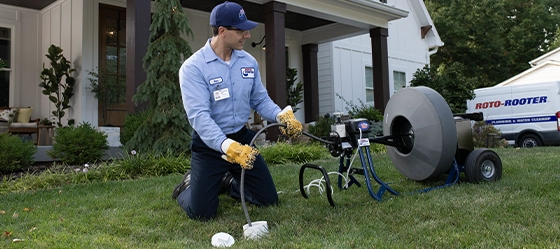
Here is a detail that gets left out of almost every description of this work, and it is the most reassuring thing about it. When a sewer lateral is replaced in Norfolk, the hole does not get filled in when the plumber is satisfied. It gets filled in when somebody who does not work for the plumber has looked into it and signed off. That is what a permit buys, and it is worth understanding, because it shapes the order everything happens in.
Does a Sewer Line Replacement Need a Permit?
Replacing a buried sewer lateral is permitted, inspected work. It is not paperwork for its own sake either: a gravity drain that is laid at the wrong fall, bedded on the wrong material, or connected badly at the far end will fail again and the household will have no way of knowing why. An inspection is the one point in the process where a second set of eyes sees the work before it disappears.
Roto-Rooter handles the permit process as part of the job. What this page deliberately does not carry is a fee, a figure or an approval timeline, and that restraint is not evasiveness. Both are set by the jurisdiction and by the scope of the specific job, and a number published on a web page becomes a promise nobody authorized. Your on-site estimate addresses it against the real work.
What an Inspector Is Actually Looking At
Not the finished surface, which is the part a Norfolk household cares about, and not the paperwork, which is already done by then. An inspection on a job like this concerns the things that stop being visible the moment the trench closes: the new pipe itself, the material it is bedded on, the fall it has been laid to, and the way it meets what it discharges into.
Which is why the trench waits. A crew that backfills before the inspection has removed the only opportunity anybody had to check, and re-opening ground to prove a point is a bad day for everyone. On any excavation Roto-Rooter runs, the sequence is deliberate, and the waiting is the feature rather than the delay.
Serving the entire Norfolk metro area, Including:
Counties in the Norfolk Metro Area
The Sequence an Excavation Has to Follow Here
Order matters more on a Norfolk excavation than on almost anything else a plumbing company does. The survey comes first and establishes that a dig is warranted at all. The scope is written from what the footage shows. Locates are requested and the marks go down. Only then does anything open, and it stays open until the pipe and the bedding have been inspected.
Read the other way round, that sequence is a set of checks a household can ask about. Has the line been surveyed? Does the scope describe a defect at a distance? Are the locates back? Is the inspection scheduled around the excavation rather than after it? A contractor with good answers to those four is describing a plan. One without them is describing an intention.
Marked Utilities Are Part of the Record
Utility locating precedes every excavation and it is a legal and safety obligation rather than a courtesy. Across Virginia, gas, electric, water and telecom occupy the same ground a sewer lateral runs through, and nothing is opened until they have been marked on the surface. Anybody offering to skip that step to save a day is offering to take a risk with your property and with a gas line.
It belongs on this page for a second reason. The locate is documented, the permit is documented and the inspection is documented, and together they are the closest thing a homeowner has to a record of buried work they will never see again. Ask for copies. On a property in Norfolk that changes hands one day, that file is worth having.
The Line That Is Yours and the Line That Is Not
The run from the building out to the municipal main is generally the property owner's and the main is generally the municipality's. Where responsibility changes hands, at the property line, at the curb or at the connection, is decided locally and Virginia jurisdictions do not all draw it in the same place. Confirm it with your own municipality rather than assuming, because it settles who pays.
Roto-Rooter works on the property owner's side of that boundary and does not undertake municipal main work. If the survey points past the connection the next call is to the city rather than to a contractor, which is one more argument for footage that reaches the far end instead of stopping at the first defect.
Open Cut, Pipe Bursting and What Each One Has to Show
An open cut works on any condition in any Virginia ground, disturbs the surface in proportion to what sits above the run, and gives an inspector the clearest possible view of the new pipe. Pipe bursting pulls a new line along the route of the old one from a pit at each end, needs existing material that will fracture and displace, workable depth and usable access, and disturbs far less ground. Lining cures a new wall inside a pipe with enough of itself left to line. Neither trenchless method is an upgrade tier and neither is universally available.
The same footage settles how much pipe has to go. One failed joint with sound, round wall either side of it is a spot repair and a much smaller job. Several separations with thinning wall along the run are the argument against patching, because eight new feet in a tired line buys a season and a second excavation through the same wet ground.
Backfill, Compaction and the Surface Above
Once the Norfolk inspection is done the trench gets closed properly rather than quickly. Backfill goes back in layers and is compacted as it goes, which matters in sandy coastal soil because loose material and a high water table together are exactly the recipe for a trench line that keeps settling long after the crew has gone.
Be straight about the rest of it. Anything paved above the run comes up and stays visible afterward, and an open cut across a lot in Norfolk disturbs the ground along the whole length of the line. Final surface restoration, meaning turf, paving or hardscape, is scoped on site and agreed before work starts rather than assumed either way. Get it written into the estimate.
While the Paperwork and the Crew Line Up
A line bad enough to justify replacing does not pause for a process. If it backs up before the work starts, emergency plumbing help in Norfolk can restore flow well enough to keep the household running. That is a holding action rather than a repair and it changes nothing the camera found. For everything else Roto-Rooter handles locally, start at the Norfolk plumbing page.
Call Roto-Rooter and Let Us Handle the Permit Process
Roto-Rooter has served Virginia property owners since 1935 and is fully licensed and insured. Call 757-671-7686 or schedule online for a camera inspection anywhere in Norfolk, and let the permit, the locates and the sign-off be somebody else's job to coordinate. Roto-Rooter provides on-site estimates before any work begins, so the scope, the footage and the process are all on the table together. On a repair this size that is the plumbing peace of mind worth having, and Roto-Rooter answers 24/7, 365 days a year.

What the Camera Has to Establish Before a Permit Is Worth Pulling
Low Coastal Ground and an Open Trench

SPECIAL FINANCING AVAILABLE
We have partnered with Synchrony Bank to offer financing options to make your plumbing repair expenses as convenient and stress-free as possible.