Sewer and Water Line Excavation in Minneapolis
Key Takeaways: What Goes Back Into a Deep Trench
- A lateral buried below the Minnesota frost line sits deep, so reaching it disturbs a tall column of ground rather than a shallow slot.
- Camera footage decides the job. A crushed length, a joint dropped out of line, a run holding standing water, or roots through a fracture are structural findings that cleaning cannot answer.
- What the new pipe rests on matters as much as the pipe. Bedding sets the fall, and a run laid on uneven spoil starts losing that fall immediately.
- Backfill goes back in layers and gets compacted as it goes. Spoil pushed in loose keeps settling through the seasons that follow.
- Trenchless is conditional, not an upgrade. Depth, the existing material, how far the pipe has failed and access at both ends decide whether pipe bursting or lining applies.
- Utility locating comes before any excavation and is not optional. Gas, electric, water and telecom all get marked.
- A Minneapolis freeze and thaw cycle works disturbed ground harder than the ground beside it, which is why compaction decides whether the yard reads flat or carries a visible trench line.
- The work is permitted and inspected, and Roto-Rooter handles that process. Roto-Rooter is fully licensed and insured.
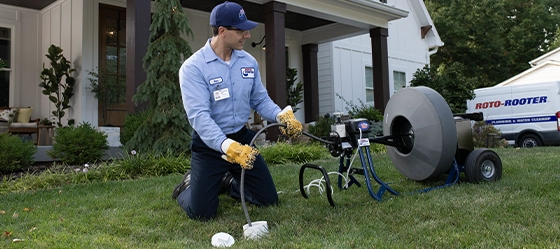
The pipe is the part everybody talks about, and it is the part that lasts longest without attention. In Minneapolis the more interesting half of a sewer replacement is the ground: how much of it has to come out to reach a line buried below the frost, what gets laid under the new pipe, and how the rest of it goes back. Get the pipe right and the bedding wrong and the fall starts drifting the week the crew leaves.
Why Does the Ground Over a Sewer Line Excavation Settle Afterward?
Undisturbed soil has spent a long time consolidating under its own weight. Excavated soil has not. When it comes out of a trench it bulks up, and when it goes back it holds air between the clods unless somebody drives that air out deliberately. Left alone, water and gravity do the compacting over the following months, and the surface drops to match.
A Minnesota winter accelerates the whole process. Moisture in loose fill freezes and expands, lifts the material above it, then thaws and drops it back into a slightly different arrangement. Ground that was never compacted properly gets reworked every season until it finds its own density, and the trench line shows on the surface as a shallow trough tracing the run.
Open Cut or Pipe Bursting When the Line Sits This Deep
Depth is what makes the two methods feel so different here. An open cut to a lateral buried this far down in Minneapolis is a large opening at the surface, because a trench that deep cannot be cut with vertical walls and has to be shored or benched back for anybody to work in the bottom of it. The volume of spoil is the reason restoration is a real line item rather than an afterthought.
Pipe bursting works from pits at each end and pulls new pipe along the route of the old one, so the disturbed volume drops sharply. It is not universally available. The existing material has to be something that will fracture and displace, the surrounding ground has to accept the displaced pipe, the depth has to be workable, and there has to be somewhere to put a pit at the far end. Those conditions are read off the footage, not assumed.
Serving the entire Minneapolis metro area, Including:
Counties in the Minneapolis Metro Area
The Trench Line You Can Still See a Year Later
The honest version of surface restoration starts with what cannot be undone. An open cut across a front yard in Minneapolis disturbs the full length of the run, and where the pipe passes under a drive, a walk or a patio, that surface comes up and will not be invisible afterward. Trenchless reduces the footprint substantially and the access pits at each end are still real openings.
What is genuinely inside a plumbing contractor's control is what happens in the hole. The work includes backfill and compaction. Final surface restoration, meaning turf, paving or hardscape, is scoped on site and agreed before work begins rather than assumed either way. Ask for that scope in writing, because it is the single most common source of disappointment on a job this size.
Bedding, Lifts and What the Inspector Sees Before It Closes
A gravity sewer works on fall alone, so the new pipe has to be supported evenly along its whole length. That support is bedding: graded material laid in the bottom of the trench and shaped so the pipe sits on it continuously rather than spanning between high spots. Backfill then goes in above it in lifts, each layer compacted before the next arrives, so the column ends up close to the density of the Minnesota ground it replaced.
The work is permitted and inspected, and the inspection belongs to this part of the job rather than to the end of it, because an inspector looks at the pipe and the bedding while the trench is still open. Roto-Rooter handles that process. What this page will not print is a permit figure or an approval timeline, because both are set by the jurisdiction and by the scope of the specific job, and a number published here becomes a promise nobody authorized. Your on-site estimate covers it against the real work.
Nothing Comes Out of the Ground Until the Locates Are In
Utility locating precedes every excavation and it is a legal and safety obligation rather than a courtesy. Gas, electric, water and telecom run through the same corridor a sewer lateral occupies, and in a deep trench the machine passes every one of them on the way down. The marks go on the ground first, and nothing is opened until they are there.
Depth raises the stakes rather than changing the rule. A shallow scrape can miss a service by luck. A trench cut to frost depth in Minnesota cannot, and anybody proposing to skip the locate to save a day is proposing to take that risk with your property and with a gas line.
One Length or the Whole Run at This Depth
A spot repair opens only the failed section, and where the camera shows a single bad joint with sound wall either side of it, that is the proportionate answer. Depth changes the arithmetic though. Most of the effort on a Minneapolis trench goes into reaching the pipe and putting the ground back, not into the pipe itself, so two spot repairs in different places cost far more than one longer opening between them.
That is a judgement made from footage rather than from a rule. A run with one defect and clean wall on both sides is a different proposition from a run showing three separations and thinning throughout, and on older Minneapolis stock where seasonal movement has worked every joint equally, the second pattern is common enough to check for specifically before committing to a patch.
Who Owns the Pipe Between the Sidewalk and the Curb?
The run from the building to the municipal main is generally the property owner's and the main is generally the municipality's, but the point where one becomes the other is set locally. It can fall at the property line, at the curb or at the connection itself, and Minnesota jurisdictions do not all draw it the same way. Confirm it with your own municipality rather than assuming, because it decides who pays.
Across Minneapolis, Roto-Rooter works on the property owner's side of that boundary and does not undertake municipal main work. If the survey points past the connection, the next call is to the city. That is a better outcome for the household, and it is another reason the footage should run all the way out rather than stopping at the first thing it finds.
The Weeks Between the Survey and the Dig
A line bad enough to justify replacement does not hold itself together on request. If it backs up before the crew arrives, emergency plumbing help in Minneapolis can restore flow well enough to keep the household running. That is a holding action rather than a repair and it changes nothing the camera found. For everything else Roto-Rooter handles locally, start at the Minneapolis plumbing page.
Request an Estimate That Covers Putting the Ground Back
Roto-Rooter has served Minnesota property owners since 1935 and is fully licensed and insured. Call 612-788-9029 or schedule online for a camera inspection anywhere in Minneapolis, and ask for the bedding, the backfill and the surface scope to be written into the estimate alongside the pipe. Roto-Rooter provides on-site estimates before any work begins, so you decide from footage and a defined scope. On a job that reaches this far into the ground, that is the plumbing peace of mind worth having, and Roto-Rooter answers 24/7, 365 days a year.

Findings That Put an Excavation on the Table
Ground That Freezes Solid and Thaws Loose

SPECIAL FINANCING AVAILABLE
We have partnered with Synchrony Bank to offer financing options to make your plumbing repair expenses as convenient and stress-free as possible.