Sewer and Water Line Excavation in Miami Gardens
Key Takeaways: Rock Below, Pavement Above
- A line that goes back to the same behavior after a proper cleaning has a structural problem, and cleaning it a third time buys the same few weeks.
- Camera footage is what a dig gets authorized from. Symptoms describe the consequence and never identify the cause.
- The ground under this part of the county is shallow limestone rather than deep soil, so an excavation here is cut rather than scooped, and the material that comes out is rock.
- What covers the run matters as much as the run. A lateral under a paved drive or a carport slab is a different proposition from one under open grass.
- Cast iron does not fail on a date. It scales, thins along the bottom of the pipe and then gives way, which is why wall condition rather than age is the thing worth measuring.
- Trenchless works on some lines and not others, and the footage decides which. Anybody offering it sight unseen is guessing.
- Roto-Rooter marks utilities before excavating, handles permits and inspection, is fully licensed and insured, and answers 24/7, 365 days a year.
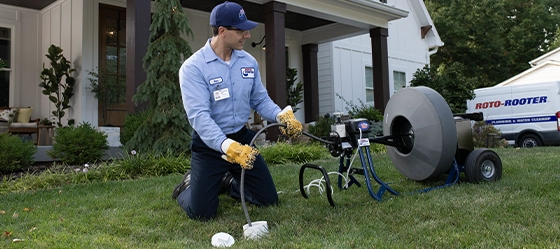
Excavation is where this service ends up once everything cheaper has been tried. By the time somebody in Miami Gardens is reading about a dig, the line has usually been cleared at least once and has gone back to the same behavior, and the useful question has shifted from how to unblock it to what is wrong with it. Answering that takes a camera, and the answer decides whether the ground gets opened at all.
Do I Need Sewer Line Replacement or Just a Cleaning?
Symptoms will not settle it. Several fixtures draining slowly, backups on a rhythm, and wet ground over the run all say the trouble is in the main, and not one of them says why. Footage separates the two possibilities that matter: something sitting inside a pipe that is still doing its job, or a pipe that has stopped being one.
The first case is a cleaning. The second is not, and no amount of skill with a cable changes that, because the run refills on the same schedule it always has. Working through it by repeating the cheap option is how households end up paying for the expensive one twice.
Cast Iron Ages on a Curve, and the Curve Matters
A great deal of the single-family stock across Miami Gardens is postwar concrete block on slab, and drainage of that vintage is commonly cast iron inside the building with cast iron or clay running out toward the street. Cast iron is durable and it does not fail suddenly. Scale builds on the interior, the usable bore narrows, and the underside of the pipe, where the flow actually sits, thins faster than the top.
That slow curve is why age alone is a poor guide. Two lines laid the same week can be in completely different condition depending on what has gone down them for decades. A camera reads wall condition, and wall condition is what decides between living with the line, repairing a length of it, or replacing the run. That is true of every vintage in Miami Gardens, whatever the plat says.
What Sits On Top of the Line Decides the Disruption
Straight talk serves you better than reassurance here. On a typical lot in Miami Gardens the run between the house and the street passes under a paved drive, a carport slab, a walkway or a patio at least once, and whatever the trench crosses has to be opened. Concrete does not go back invisibly: a saw cut stays a saw cut, and the patch shows afterward no matter how neatly it is finished.
Backfill and compaction are part of the work, and with rock spoil that step earns attention rather than assumption, because material that is not compacted properly keeps settling for months and leaves a trough along the trench line. Surface work beyond that, meaning paving, hardscape or planting, gets scoped on site and written into the estimate rather than left to be argued about later. Ask for it in writing.
Locating Comes Before Cutting
Gas, electric, water and communications lines share the ground a sewer lateral runs through, and they are located and marked before an excavation starts. That is a legal and safety obligation rather than a preference, and no crew worth hiring treats it as negotiable for the sake of a day in the schedule. It is also a fair test of who you are dealing with, and it is standard on every excavation Roto-Rooter runs in Florida.
Permitting and inspection apply to this work, and Roto-Rooter handles that process as part of the job. No permit figure and no approval timeline appear on this page, because both vary with jurisdiction and scope and neither is ours to promise. Roto-Rooter provides on-site estimates before any work begins, and the permitting sits inside that scope.
The Line to the Street, and Who Owns It
The usual arrangement is that the property owner is responsible for the lateral serving the building and the municipality is responsible for the public main. Exactly where one becomes the other is a local determination and it differs between jurisdictions, so it is a question for your municipality rather than something to take from what a neighbor was told. It decides who carries the cost, which makes it worth five minutes of asking, and the answer in Miami Gardens is not necessarily the answer one town over.
Roto-Rooter works on the private side of that boundary. Public main work belongs to the municipality, so if an inspection points past the connection, the next call is to the city and not to a contractor.
One Section or the Whole Length
A structural finding does not automatically mean replacing everything. Where the footage shows a single failure in pipe that is otherwise in good condition, opening only that section is a substantially smaller job and the right call. Where it shows scale, thinning and separations distributed along the run, it is not, because a short replacement inside a line that is failing everywhere returns you to the same conversation inside a year or two.
On older cast iron that distributed pattern is common enough to be worth looking for specifically before agreeing to a spot repair. The footage makes it visible, and that is the second time on this job the camera earns its keep.
Living With the Line Until the Work Happens
A run in this condition rarely waits quietly for an appointment. If it backs up before the repair, emergency plumbing help in Miami Gardens can get flow moving again so the household keeps functioning, on the understanding that it is a stopgap and changes nothing about the footage. Going easy on the line in the meantime helps: fewer heavy loads at once, nothing greasy down the kitchen side, and no chemical opener poured into a pipe somebody has to work on by hand. For everything else Roto-Rooter covers here, start at Roto-Rooter in Miami Gardens.
Book a Camera Inspection Before Any Excavation
Roto-Rooter has worked on sewer lines since 1935, is fully licensed and insured, and answers 24/7, 365 days a year across Miami Gardens and this corner of Florida. Call Roto-Rooter at 305-907-2132 or schedule online to get a camera into the line. Roto-Rooter provides on-site estimates before any work begins, so the footage and the scope arrive together and the decision is yours to make from evidence rather than from a description. On a job this size that is where the plumbing peace of mind comes from.

What Footage Has to Show Before a Yard Gets Opened
Limestone Close to the Surface, and Pipe From Another Era
