Hydro Jetting in Miami
Key Takeaways: The Question Is Whether the Wall Can Take It
- A buried pipe in Miami is worked on from two directions. The deposit builds on the inside, and shallow groundwater and salt-laden air go after the metal from the outside at the same time.
- That reverses the usual order of questions. Before anybody asks what is coating the line, somebody has to establish how much pipe is still there.
- A video camera inspection is not a formality here. It is the whole basis of the decision, and it runs again afterward to show the wall is genuinely clear.
- Hydro jetting cleans the full circumference of the pipe wall, where a cable bores an opening through the blockage and leaves the coating in place.
- On a sound line the usual suspects apply: grease from a kitchen, soap and paper, sludge in a shallow run, mineral scale in cast iron that wants descaling.
- Tree roots find a seam quickly in a climate with no dormant season, and a rootlet mat catches everything moving slowly past it.
- Where the wall is thin, badly offset or collapsed, the honest answer is a repair conversation, and hearing it before the hose goes in is the point of looking.
- Roto-Rooter is fully licensed and insured and answers across Miami 24/7, 365 days a year.
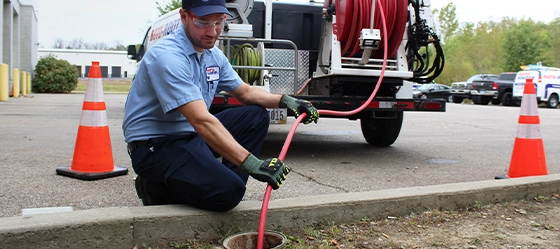
Everywhere else the interesting part of a sewer line is what is inside it. Along this coast the pipe itself is a live question. Groundwater in Miami sits close to the surface, it is brackish in the districts nearest the water, and the air carries salt far enough inland to matter. Buried iron in that combination loses material from the soil side, steadily, for as long as it is in the ground, and nothing about the inside of the pipe tells you it is happening.
Pipe Gets Attacked From Both Sides Here
Picture two processes running in parallel on the same length of cast iron. Inside, grease sets along the crown, soap and paper build on top of it, and mineral scale narrows the bore from the wall inward. Outside, moisture and salt take the wall in the other direction. A line can be losing diameter and losing thickness simultaneously, and the household sees only the first as a slow drain.
This is why a Miami property that has been cabled two or three times deserves more than a fourth cabling. Each of those visits answered the flow question and none of them answered the condition question, because a cable tells you nothing about a pipe except that something in it gave way. Florida ground does not make that a safe assumption to carry for decades.
Where Hydro Jetting Fits on a Coastal Line
On a sound run it is the right tool and it is not a close call. A nozzle throws water backward against the pipe wall while the hose is drawn along the line, so the scour covers the full circumference instead of the middle. Grease that cooled and set comes off the crown. Sludge lying in a shallow stretch is carried out toward the main rather than nudged along it. Mineral scale in cast iron is cut back toward the original bore, which is the descaling half of the work. Root hair left at a seam after a cutter head is stripped away with everything caught on it.
That is the difference between clearing a clog and cleaning a sewer line, and it is why Roto-Rooter treats end-to-end cleaning as the standard rather than an upgrade. The qualifier is the same one that runs through this whole page. High-pressure water is a cleaning tool and it assumes the pipe can take it, so in Miami the camera earns its place at the front of the job rather than the end.
Serving the entire Miami metro area, Including:
Counties in the Miami Metro Area
The Verdict That Stops the Work Before It Starts
Three findings take cleaning off the table. A collapsed length has no bore left to recover. A joint badly offset, one section shifted out of line with the next, catches the hose and signals a structural fault that no cleaning addresses. A wall worn thin may not survive the work, and for the reasons above that third one is more common in Miami than it is in a dry inland market.
When the camera says so, the honest answer is that the job is a repair, scoped from footage that already exists. That is a worse answer than cleaning and it is a much better answer than finding out with a hose in the line. For everything else the local team handles, Miami plumbers is the place to start.
Kitchens That Never Close
A house lateral and a restaurant run differ in diameter, in daily volume and in what a failure costs. A residential line in Miami that has been properly cleaned can go a long while before it needs attention again. A kitchen operating seven days a week, through a season that never really slows, is working against an accumulation rate it cannot argue down, which is why food service operators across Florida generally put line cleaning on a calendar instead of waiting for the service that ends early. The condition question applies to them twice over, because a commercial run is usually older, larger and harder to get at than a house line.
Is Hydro Jetting Safe on Old Cast Iron in Salt Ground?
On sound iron, yes, and the pressure is aimed at the deposit rather than at the pipe. The honest part of the answer is that soundness is not a given here and cannot be assumed from age alone. Two lines of the same vintage on the same Miami street can be in very different condition depending on how wet the ground around them stays and how much salt reaches them. That is precisely why the inspection comes first and why a technician who has watched your footage will tell you plainly when the answer is no.
If the line is backing up right now rather than slowly declining, start with emergency plumbing help in Miami. Getting the water moving comes first and the condition conversation follows.
What Happens Between the Two Camera Runs
A technician locates the cleanout, sends the camera through and goes over the footage with you before any water goes in. If the pipe is a candidate, the hose is drawn along the run and the wall is cleaned back toward its original diameter, then the camera repeats the trip so the difference is visible rather than asserted. Roto-Rooter provides on-site estimates before any work begins.
Access is the practical variable on a Miami property. Some have a cleanout in an obvious spot outside the foundation, others had one paved over or planted over, and some never had a usable one installed. Mentioning that on the phone is more useful than discovering it in the driveway. Where none exists, the inspection covers what adding one would take, because a line that has needed help twice will need it again and every later visit is easier for it. A pipe in this ground will be looked at more than once over its life, so the access point is worth treating as part of the plumbing rather than an afterthought.
Call for a Condition Check on Your Miami Line
Roto-Rooter has cleaned drains and sewers across Florida since 1935 and is fully licensed and insured. Call 305-535-2373 or schedule online to find out what condition your pipe is in before anybody puts anything down it. Miami crews answer 24/7, 365 days a year, which is the plumbing peace of mind of knowing rather than assuming.

The Fouling a Coastal Run Actually Collects
Warm Ground, Salt in the Air, and a Wet Season

SPECIAL FINANCING AVAILABLE
We have partnered with Synchrony Bank to offer financing options to make your plumbing repair expenses as convenient and stress-free as possible.