Sewer and Water Line Excavation in Manhattan
Key Takeaways: What Excavation Means With No Yard to Dig In
- When a drain problem reaches every stack in a building rather than one apartment, the house connection is the suspect and the camera is how that gets confirmed.
- One line usually serves an entire building in Manhattan, so a structural failure is a building-wide event rather than a household inconvenience.
- The run reaches the municipal main under a public sidewalk and roadway, not across private ground, which changes who has to authorize the opening.
- Utility locating carries more weight in Manhattan than almost anywhere. Gas, electric, water, steam and telecom occupy the same ground the sewer lateral crosses.
- Trenchless is worth asking about early, because the alternative is a cut in a roadway, but pipe bursting and lining stay conditional on depth, material and access.
- Roto-Rooter works on the owner's side of the connection. Municipal main work belongs to the city and is not something a plumbing company undertakes.
- The job is permitted and inspected and Roto-Rooter runs that process. Roto-Rooter is fully licensed and insured.
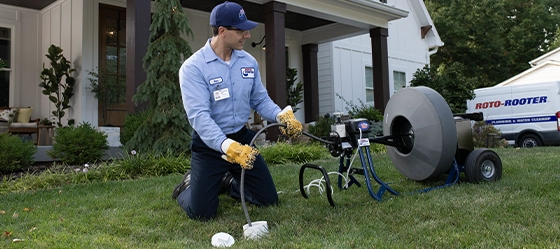
The excavation conversation starts from a different place in Manhattan, because there is no lawn to trench and no driveway to cut. Between a building wall in Manhattan and the main there is a public sidewalk and a roadway, and the decision to open either of them is not one a plumber makes alone.
One Line, Every Apartment in the Building
Scale is what separates the work in Manhattan from a house call. A single house connection carries the waste of every unit above it, so the symptom pattern is different: fixtures backing up on more than one floor at once, a cellar-level floor drain surcharging, and relief that lasts days rather than months after a cleaning. Those are the readings that put the buried run under suspicion instead of a branch inside the building.
The camera settles it. Four findings move a line out of the cleaning category and into replacement. A collapse leaves no bore to restore. A severe offset, where one section sits proud of the next, catches solids permanently. A belly holds standing water in the sag, so the run loads up again after every cleaning. And a break admitting roots or soil is an opening that returns the moment the obstruction is cleared. Under a building with forty households on the line, the difference between those and simple buildup is worth establishing before anybody talks about a sewer line replacement under a public street.
Open-Cut or Pipe Bursting When the Street Is the Site
Open-cut is the direct method: a trench along the run, the old sewer lateral out, the new pipe bedded and backfilled, then the surface restored. In Manhattan that surface is concrete walk and roadway, and the cut has to be plated, guarded and worked around traffic and pedestrians for as long as it is open.
That is exactly why trenchless gets a serious hearing here before it does in a market with a front lawn. Pipe bursting pulls a new line along the path of the old one from a pit at each end, and lining cures a new wall inside the existing pipe, so both reduce the opening to a fraction of the run. Neither is automatic. Depth, the material and condition of the host pipe, the degree of collapse and whether a usable pit location exists at both ends all decide it, and in a place where one end of the run is inside a cellar and the other is under a travel lane, that access question is a real one rather than a formality.
Serving the entire Manhattan metro area, Including:
Counties in the Manhattan Metro Area
The Most Crowded Ground in the Country Gets Marked First
Utility locating comes before anything is opened, and in Manhattan that step is neither quick nor optional. Gas, electric, water, steam and telecom all have to be identified and marked before a Manhattan excavation starts, and the consequences of guessing are not measured in property damage alone. Nothing is excavated until the marks are down. Anyone proposing to save time by working around that step is proposing to take a risk with a live service under a public street.
The work is permitted and inspected, and Roto-Rooter handles that process rather than leaving it with a building owner or a managing agent. What is deliberately absent from this page is a permit fee or an approval timeline, because both vary by jurisdiction and with the scope of the specific job, and a number published here would turn into a commitment nobody made. It is covered in the on-site estimate against the actual work.
Whose Line Is It When Nobody Owns a Yard?
The general principle holds even without a front yard: the house connection running from the building out to the municipal main is the property owner's, and the main itself is the municipality's. Where exactly one becomes the other is set locally and it varies, so it is worth confirming with your municipality rather than assuming, in Manhattan as anywhere else in New York. On a multi-tenant building it also decides which party inside the building is answering for the work, which is a separate question worth settling early.
Roto-Rooter works on the property owner's side of that boundary. If the survey points past it, the next call is to the city, because municipal main work is not something a plumbing company takes on.
Sidewalk, Curb and Roadway After the Excavation
Honesty serves better than reassurance. An open cut in a public walk or a roadway is visible work: it is barricaded, plated when it has to carry traffic, and the surface over it will not match what was there before. Pipe bursting reduces that to two pits, which is the strongest argument for it in a place like Manhattan and the reason the question deserves an early answer. In a market where the alternative is a New York roadway opening, the difference is not cosmetic.
Backfill and compaction are part of the work, and under a traveled surface they matter more than under turf, because a poorly compacted trench under a sidewalk or a traffic lane announces itself as a depression within months. Final surface restoration is scoped on site and agreed before work begins rather than assumed, and where a public surface is involved it follows the standard the jurisdiction sets rather than a preference.
Replacing Part of a Line the Whole Building Depends On
Not every structural finding means the entire connection comes out. Where the camera shows one failed joint in a run that is otherwise sound, opening only that length is a materially smaller job, and in a street opening that difference is worth real money and real disruption.
What decides it is the condition either side of the defect, and the load the line carries. A connection serving one family and a connection serving thirty apartments do not age at the same rate, and a run under Manhattan showing several separations and heavy scale along its length is telling you a spot repair buys months. Going back into the same roadway a second time is the outcome to design against.
Keeping a Full Building Running Until the Work Starts
A connection this far gone does not hold politely until a permit clears. If it backs up in the interim, emergency plumbing help in Manhattan can restore flow so the building stays usable. That is a holding action, not a repair, and it changes nothing about what the footage showed. For the rest of what is handled locally, start at the Manhattan plumbers page.
Schedule a Camera Inspection of the Building's Line
Roto-Rooter has been diagnosing and replacing sewer lines since 1935 and is fully licensed and insured. Call 212-687-1662 or schedule online to get a camera into the connection before anybody proposes opening a street. Roto-Rooter provides on-site estimates before any work begins, so the footage and the scope arrive together. On a building-wide repair that is the plumbing peace of mind worth having, and Roto-Rooter answers 24/7, 365 days a year.

What the Camera Reports on a Building's House Connection
One Line, Many Households, and a Street Full of Everything Else

SPECIAL FINANCING AVAILABLE
We have partnered with Synchrony Bank to offer financing options to make your plumbing repair expenses as convenient and stress-free as possible.