Sewer and Water Line Excavation in Los Angeles
Key Takeaways: Two Buried Lines, Two Completely Different Digs
- Pressure that has dropped at every tap, and rust coloring the first draw of the morning, point at the buried water service rather than at anything inside the walls.
- A supply leak under a concrete drive can run for a long stretch with no wet patch anywhere, because the water travels along the pipe bedding and leaves at the curb.
- The sewer side works the opposite way. A camera goes in before anything else, and the footage is what separates a line that needs cleaning from a line that needs replacing.
- Four findings close the cleaning argument: a collapse, a severe offset, a run that has sagged and now holds water, and roots arriving through a broken joint.
- Trenchless is conditional rather than an upgrade. Depth, the material and condition of the existing pipe, and usable access at both ends decide whether it is on the table.
- Utility locating happens before ground opens. Gas, electric, water and telecom are all marked, and on a lot where the run crosses a driveway there is rarely only one of them.
- Where responsibility for the line running out to the street ends is set locally, so that boundary is a question for your municipality rather than something to assume.
- Roto-Rooter is fully licensed and insured, and the permitting and inspection that the work requires is handled as part of the job.
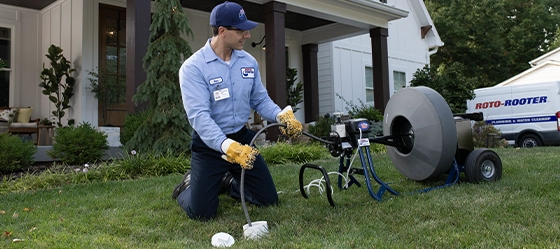
Two pipes leave a house and cross the same front yard, and they fail in ways that have almost nothing in common. One carries water in under pressure. The other carries waste out under gravity. Across the older neighborhoods of Los Angeles both were laid in the same decades, out of materials that had a working life nobody expected to be tested this far, and either one can put you in the position of needing ground opened.
Pressure, Rust and a Leak With Nowhere to Surface
Galvanized steel was the standard supply material for a long era of building in California, and it corrodes from the inside outward. The bore narrows with scale until pressure falls off at the shower and the hose bibb, then a pinhole opens somewhere along the buried run. What makes this hard to catch is that the run is not sitting in open dirt. It is sitting in a trench that was backfilled with looser material than the ground either side, under a driveway or a walkway, and that trench behaves like a drain. Water leaving a pinhole follows it and shows up at a curb joint or a planter edge, tens of feet from the actual failure.
The tells are a water meter that keeps turning with every fixture shut, a warm strip across a slab or a walk where a supply line runs, and pressure that has fallen off gradually enough that nobody noticed the month it changed. Locating equipment narrows the leak to a working area before anything is cut, because on a lot with this much paving the cost of guessing is measured in square feet of concrete.
Does a Water Line Leak Mean Excavation Too?
Sometimes, and the alternative is worth asking about. A supply line is smaller and shallower than a sewer lateral, so replacing one is a lighter job than replacing a sewer, and a new line can occasionally be routed on a fresh path that avoids the worst of the hardscape rather than following the old trench. Where the failure is a single accessible point, a spot repair may hold. Where the pipe is failing along its length because the whole run has thinned, replacing a foot of it buys a season.
The sewer side never skips the camera. Recurring backups, several fixtures draining slowly at once, and water surfacing over the run all point at the main line without saying why, and the difference between an obstruction that can be removed and a pipe that has failed structurally is not something anyone should be reasoning about from the symptoms.
Serving the entire Los Angeles metro area, Including:
Counties in the Los Angeles Metro Area
Utility Locating Before a Water Line Excavation
Nothing is cut until the marks are down. Gas, electric, water and telecom share the same shallow band of ground a service line occupies, and streets across Los Angeles have had utilities added, rerouted and undergrounded over a long enough history that what is actually down there does not always match what anyone expects. Locating is a legal and safety obligation in California, it is arranged before the crew arrives, and a contractor willing to skip it to save a day is offering to gamble with a gas main.
The work is permitted and inspected, and Roto-Rooter handles that process as part of the job. What is deliberately absent from this page is what a permit costs or how long an approval runs, because both vary by jurisdiction and by the scope of the specific job, and a number published here would become a promise nobody authorized. Your on-site estimate addresses it against the real work.
Curb, Property Line or Connection?
The general shape is consistent: the lateral running from the building out toward the street belongs to the property owner, and the main belongs to the municipality. Where exactly the handover falls, at the property line, at the curb, or at the connection itself, is decided locally and it genuinely differs between jurisdictions. That matters more here than in most markets, because the Los Angeles service area takes in dozens of separately incorporated cities alongside unincorporated county ground, and they do not all draw the line in the same place. Confirm it before assuming, because it decides who pays for what, and it is the single most common misunderstanding on a job this size.
Roto-Rooter works on the property owner's side of that boundary. Municipal main work is not something a plumbing company takes on, and if the camera points past the connection, the next call is to the city rather than to a contractor.
Backfill, Compaction and a Saw Cut in the Slab
Being straight about this beats being reassuring. An open-cut trench disturbs the ground along its whole length, and where the run passes under a drive, a walkway or a patio, that surface has to be opened. A saw cut in concrete does not disappear afterwards, and anyone who tells you otherwise is selling. Trenchless methods shrink the footprint considerably, which is exactly why they are worth asking about, though the pits at each end are still excavations and they still land somewhere on the property.
The job includes backfill and compaction, which matters more than it sounds. Backfill that was not compacted properly keeps settling for months and leaves a trough along the trench line, and under a slab that means a crack. The replacement itself is carried out to California plumbing code and signed off by inspection. Final surface restoration, meaning turf, paving or hardscape, is scoped on site and agreed before work starts rather than assumed in either direction. Ask for it in writing with the estimate.
How Much of the Line Actually Comes Out?
A structural finding does not automatically mean the whole run. Where the footage shows one failed joint or a single crushed length in a pipe that is otherwise sound, a spot repair opens only that section and is a substantially smaller job. What settles the question is the condition of everything either side of the defect.
This is where the inspection earns its keep a second time. A line with one problem and clean wall on both sides of it is a different proposition from a line with three separations and scale throughout, and on stock of this age the second pattern turns up regularly enough to be worth ruling out specifically before anyone commits to the smaller repair.
If the Line Backs Up Before the Dig
A lateral bad enough to be scheduled for replacement rarely behaves itself while it waits. If it backs up in the meantime, emergency plumbing help in Los Angeles can restore flow so the household keeps running. That is a holding action and it changes nothing about what the camera found. For everything else handled locally, start at Los Angeles plumbers.
Book a Line Inspection Before Anyone Breaks Concrete
Roto-Rooter has been in the plumbing business since 1935, answers 24/7, 365 days a year, and is fully licensed and insured. Call 661-257-9200 or schedule online to have the line located and inspected. Roto-Rooter provides on-site estimates before any work begins, so you see the evidence and the scope together and decide from that. On a repair that involves opening your driveway, that is the plumbing peace of mind worth paying attention to.

What Justifies a Sewer Line Replacement on an Older Lot
Galvanized Supply, Clay Sewer and Ground That Barely Moves

SPECIAL FINANCING AVAILABLE
We have partnered with Synchrony Bank to offer financing options to make your plumbing repair expenses as convenient and stress-free as possible.