Hydro Jetting in Kansas City
Key Takeaways: What Hard Water Leaves on the Inside of a Drain
- A line that has been getting slower for years with nothing dramatic ever coming out of it is usually lined rather than blocked, and the lining is what a cable rides straight through.
- Mineral-heavy supply water and ordinary soap combine into a film that will not dissolve. Chemical drain cleaners are aimed at organic matter and this is not organic matter.
- Hydro jetting scours the whole circumference of the pipe back to the wall, which is the only mechanical way to take a bonded deposit off rather than bore through it.
- Descaling older cast iron is a related but separate job: there the deposit is the pipe corroding inward, and the camera tells the two apart at a glance.
- A video camera inspection runs before anything is pressurized, because a thin, offset or collapsed pipe is not a candidate no matter what is coating it.
- Grease and tree roots still account for plenty of work in this metro. The point is that in Kansas City they are not the only thing narrowing a sewer line.
- One slow fixture is a different service. That is Kansas City drain cleaning, and it is faster and cheaper than bringing a jetting truck out.
- Roto-Rooter is fully licensed and insured and answers 24/7, 365 days a year.
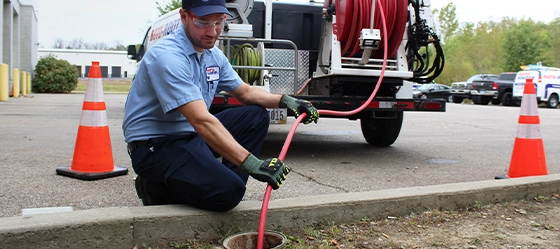
Water in this part of Missouri arrives carrying a mineral load it picked up on the way. That is the ordinary consequence of drawing from the Missouri River in limestone country, and most of what it means for a household is a spotted glass and a stiff towel. Inside a drain line it means something else.
Soap, Minerals and a Deposit That Does Not Dissolve
Soap and the calcium and magnesium in hard water react. What they produce is not soap any more and it is not soluble, and it does not leave with the water. It plates onto the inside of a bath branch and a laundry branch a little at a time, and because it arrives evenly rather than as a lump, nothing about it announces itself. Nobody gets a backup. The tub takes a few seconds longer to empty than it did, and then a few seconds longer than that.
By the time somebody in Kansas City calls about it, the run has been narrowing for years. A cable sent into that line finds no blockage to break, because there is no blockage. It passes through the middle of a tube that has been getting smaller and comes back out reporting that the line is clear, which it technically is.
How Does Hydro Jetting Take Off Something a Chemical Cleaner Cannot?
Mechanically, and from the wall outward rather than the middle in. A hose carries a nozzle that aims high-pressure water backward against the pipe while the hose is drawn along the run, so the water works on the full circumference instead of on whatever happens to be in the center. A bonded film has to be sheared off, and that is what the method does. Grease that has cooled and hardened along the crown comes away the same way. Sludge sitting in a stretch with little fall is carried out instead of pushed further down. Where the deposit is the corrosion product of old cast iron, descaling cuts it back toward the bore the pipe started with.
That distinction is the whole argument. Clearing a clog is an emergency errand. Cleaning a pipe is maintenance, and the two get confused because the truck shows up for both.
The camera does two jobs and the first one carries more weight. Before the hose goes anywhere it establishes that the pipe can take the work, and it shows what fouled the run, because a mineral film, a grease layer and a root intrusion look nothing alike on a screen and none of them calls for the same answer. Afterward the camera goes back down the same stretch, which is the only honest way to show a wall is clear rather than merely flowing again, and it is worth asking any company for.
Serving the entire Kansas City metro area, Including:
Counties in the Kansas City Metro Area
When the Camera Says Do Not Pressurize
High-pressure water assumes a pipe capable of taking it, and three findings end that assumption. A collapsed length has no bore left to recover. A joint offset badly enough that one section no longer lines up with the next will catch a hose, and the misalignment is the real problem in any case. A wall already thinned by decades of corrosion may not survive a cleaning, and the inspection exists to establish that before anyone learns it the expensive way.
When one of those turns up, the honest answer is that cleaning is not the fix. Jetting cleans a pipe. It does not repair one and it never has, and a company that pressurizes a failing line anyway has sold a customer a few months. What follows instead is a repair conversation built on the footage the camera already produced.
Restaurant Lines Load Faster Than House Lines
Diameter, volume and consequence all differ. A house lateral in Kansas City that has been cleaned back to the wall can go a long stretch before it needs attention again, and how long depends entirely on what put the deposit there in the first place: a mineral film rebuilds at the pace the water supplies it, and grease rebuilds at the pace the kitchen supplies it. An operator running a full service every day is working against a rate they can measure, which is why commercial kitchens across Missouri tend to move onto a planned interval rather than wait for a Friday night.
Roto-Rooter takes both. For everything else a property here needs, start at the Kansas City plumbing team.
Getting to the Cleanout
A technician finds the cleanout, puts the camera in and walks you through what is on the screen before any decision is made. If the line is a candidate, the hose goes in and the affected stretch is cleaned, then the camera goes back down so the wall can be seen rather than described. Roto-Rooter provides on-site estimates before any work begins, so the scope and the number arrive at the same time.
Access is the variable that changes a visit. A cleanout in the open makes for a short one. A cleanout buried under landscaping, finished over during a remodel, or never installed at all changes the approach, and it is better mentioned on the phone than discovered in the driveway. Where none exists, the inspection covers what adding one to Missouri plumbing code would take, since a line that has needed help twice will need it again.
What Changes Once the Wall Is Clean
Bore comes back first. A pipe returned to something near its built diameter moves what it was sized to move, so the slow tub, the gurgling floor drain and the fixture that backs up when the washer empties tend to clear together rather than one at a time. The second thing you get is a record. Footage of your own line, taken after it was cleaned, is a baseline you can hold a future inspection against instead of starting the argument over.
If a line is actively backing up rather than quietly narrowing, that is a different call. Start with emergency plumbing help in Kansas City and deal with the cleaning once the flooding has stopped.
Call About a Scaled Line in Kansas City
Roto-Rooter has been clearing and cleaning drains since 1935, and is fully licensed and insured. Call 816-412-2103 or schedule online to get a camera into the line and find out what is actually coating it, and get the plumbing peace of mind of a decision made from footage. Roto-Rooter answers 24/7, 365 days a year.

The Conditions Hydro Jetting Is Built For
Limestone Ground, Mineral Water and Cast Iron

SPECIAL FINANCING AVAILABLE
We have partnered with Synchrony Bank to offer financing options to make your plumbing repair expenses as convenient and stress-free as possible.