Hydro Jetting in Jersey City
Key Takeaways: When the Pipe Runs Under Public Ground
- On a lot built out to its edges, the sewer line leaves under a stoop, crosses a sidewalk and joins a main under a street, so almost none of it is anywhere you could simply open up.
- That changes the economics of maintenance rather than the plumbing. Cleaning a line properly is inexpensive next to excavating one, and the gap is wider here than in a place with a front lawn.
- A cable bores through the blockage and restores flow. Everything bonded to the wall stays, and on a run this hard to reach that is the difference between a maintenance item and a project.
- Hydro jetting scours the full circumference back to the pipe wall, along the run rather than at the one point where flow stopped.
- A video camera inspection is not optional on a buried line nobody can uncover. It is the only way to know whether the pipe is sound before pressure goes anywhere near it.
- Grease, mineral scale and root hair remaining after a cutting head are three different findings with three different answers, and the footage separates them.
- A single slow fixture inside the building is a smaller job. That is Jersey City drain cleaning.
- Roto-Rooter is fully licensed and insured and answers 24/7, 365 days a year.
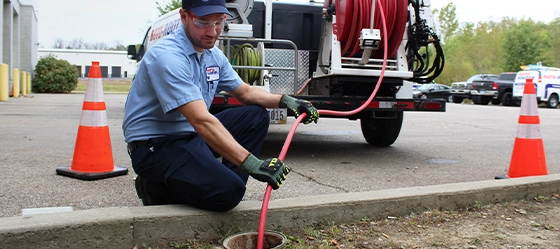
Ask where a lateral runs on a typical lot in Jersey City and the answer is: under the front steps, under the sidewalk, and out into the roadway. There is no side yard to speak of and often no front yard either. Every foot of that pipe is under something somebody else has an interest in, and that single fact reorders what is worth doing to it.
What Hydro Jetting Does Along the Whole Run
A hose carries a nozzle down the line, and the nozzle directs high-pressure water backward against the pipe wall while the hose is drawn along the sewer line. The cleaning happens around the full circumference and across the length rather than at a single point, which is the difference between removing a deposit and making a passage through one. Grease that cooled and set along the crown comes off. Sludge lying in a stretch with little fall is carried out. Where cast iron has corroded inward, descaling takes the buildup back toward the original bore, and root hair left after a cutting head is stripped from the joint that admitted it.
A cable does something narrower and does it well. It reaches the obstruction, opens a passage and gets the fixtures draining, which is exactly right during a backup at midnight. What it leaves is the coating, and the coating is why the same line closes again on its own schedule.
Why Does the Cleaning Method Matter More Where Digging Is Hard?
Because the alternative is not a weekend of work in a garden. Reaching a pipe under a public sidewalk or a roadway means permits, traffic management, restoring the surface afterward and coordinating with whoever else has something buried in the same trench. None of that is unusual and all of it is expensive, and it is why a property owner in a dense New Jersey block is better served by keeping a sound pipe genuinely clean than by cabling it once a year until it fails.
The corollary matters just as much. If the line is not sound, you want to know now rather than during the third backup, because planning an excavation is an entirely different experience from responding to one. That is what the camera buys.
Serving Jersey City and surrounding communities, Including:
Counties in the Jersey City Area
When Opening the Ground Is the Only Answer Left
Three findings take cleaning off the table. A collapsed section has no bore left to restore. A joint offset far enough that one length no longer meets the next will catch a hose, and the misalignment is the real fault whatever is coating it. A wall thinned by long corrosion may not survive the work. In each case the answer is that cleaning is not the remedy, because jetting cleans pipe and has never repaired any.
Saying so early is the whole value of an inspection on a lot like this. A repair planned from footage can be scoped, permitted and sequenced, and in some cases handled as a trenchless repair rather than an open cut across a sidewalk. A repair discovered during a failure is the same work done in the worst possible order.
Hydro Jetting on a Commercial Line in a Tight Block
A house lateral and a working kitchen line differ in diameter, in daily loading and in what it costs when they stop. A residential run cleaned back to the wall may go years before needing attention, depending on what put the deposit there. An operator putting service volume down the same pipe every day is working against a rate they can measure, and where the line is under a public sidewalk the case for a planned interval is stronger still: a scheduled visit is a quiet morning, and an unscheduled one is a closed kitchen on a street with nowhere to park a truck.
Roto-Rooter handles both. For anything else a property here needs, start with Jersey City plumbers.
Where the Cleanout Hides on a Built-Out Lot
The visit begins at the cleanout. A technician locates it, runs the camera and talks through what is on the screen before anything is decided. If the line is a candidate the hose goes in, the affected stretch is cleaned, and the camera goes back down so you can look at the wall instead of taking a description of it. Roto-Rooter provides on-site estimates before any work begins.
Finding that access point is genuinely half the work in this housing. Cleanouts end up inside, behind finished walls, under a stoop, or occasionally nowhere at all because the building predates the expectation of one. It is worth raising on the phone rather than in the entryway. Where none exists, the inspection covers what adding one to New Jersey plumbing code would involve, and on a line this hard to reach that is usually money well spent.
What You Own Afterward
Bore comes back first. A pipe returned to something near its built diameter carries what it was sized to carry, so the slow drain, the gurgle and the fixture that backs up when a washer empties tend to resolve at once. Then there is the recording, and in Jersey City it is worth more than usual. On a line running under public ground, footage of its condition is a genuinely valuable document: it is what a future contractor, a future buyer or a future dispute gets measured against.
If water is coming up now rather than slowly getting worse, that is a different call. Start with emergency plumbing help in Jersey City and take up the cleaning once the flow is back.
Contact Roto-Rooter About a Line in Jersey City
Roto-Rooter has been clearing and cleaning drains since 1935, and is fully licensed and insured. Call 201-942-3073 or schedule online to get a camera into the run before anybody talks about opening a sidewalk, and get the plumbing peace of mind of knowing what is down there. Roto-Rooter answers 24/7, 365 days a year.

The Findings That Call for a Hose
Narrow Lots, a Stoop and a Sidewalk Over the Line

SPECIAL FINANCING AVAILABLE
We have partnered with Synchrony Bank to offer financing options to make your plumbing repair expenses as convenient and stress-free as possible.