Sewer and Water Line Excavation in Jersey City
Key Takeaways: Excavation a Few Feet From a Wall You Do Not Own
- A Jersey City line that backs up again soon after every cleaning is pointing at the pipe rather than at what is in it, and a camera inspection is what tells the two apart.
- On an attached lot the trench runs close to a neighboring footing, so how near the excavation can safely come is settled before a method is chosen.
- Older Jersey City buildings sit on masonry footings that rely on the ground beside them, which is an engineering constraint rather than caution.
- Reaching the run may require access across ground the property owner does not control, and that gets arranged rather than assumed.
- Trenchless work is conditional on depth, the material and condition of the pipe, the degree of collapse and somewhere to put a pit at each end, and a party wall can remove one of those places.
- Utility locating happens before any digging and is not optional. Gas, electric, water and telecom run dense through a corridor this narrow.
- The work is permitted and inspected and Roto-Rooter handles that process. Roto-Rooter is fully licensed and insured.
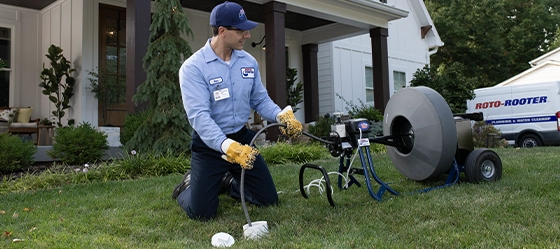
On a twenty-five foot lot with buildings on both sides, a sewer lateral does not have a yard to itself. It runs down a strip of ground shared with a wall that belongs to somebody else, and everything about repairing it, how the trench is cut, how it is held open, where equipment can stand, follows from that fact rather than from the pipe. Jersey City is built like that across whole neighborhoods, and it is the first thing worth understanding before the word excavation comes up.
Can a Sewer Line Be Replaced Between Two Attached Buildings?
Routinely in Jersey City, and it is planned rather than improvised. The starting point is the same everywhere: a camera survey that establishes what is wrong, where along the run it sits, and how deep. Four findings end the cleaning conversation. A collapsed section has no bore left to work through. A severe offset leaves a lip that catches everything passing. A belly holds standing water, so solids settle out and the line silts up again on a cycle. Roots through a broken joint mark an opening that will readmit them after cutting.
What changes on an attached row is the second half of the survey, which is the site rather than the pipe. Where does the defect sit relative to the party wall? How far is it from the front of the building? Is there a way in from the rear, and does it cross ground the owner controls? Those answers decide the method as firmly as the footage does, and any estimate produced without them is a guess wearing a number.
Sewer Line Replacement Beside Someone Else's Foundation
Masonry construction of this era, which is most of older Jersey City, sits on footings that depend on the soil beside them staying where it is. Cut a trench too close and you remove that support, which is a risk to a structure rather than an inconvenience, and on an attached building it is a risk to two of them. So the excavation is set out at a safe distance, supported properly along its length, or approached from a different direction entirely. A crew that treats this as routine is not being slow, it is being correct.
It is also the strongest practical argument for a trenchless method here. Pipe bursting draws a new line along the route of the old one from pits at each end, and lining cures a new wall inside the existing pipe, so both leave the ground between those points undisturbed. Neither is available on request. Depth, the material and condition of the pipe, the degree of any collapse and whether there is a workable place for a pit at both ends decide it, and on a narrow New Jersey lot that last condition is the one that fails most often.
Serving Jersey City and surrounding communities, Including:
Counties in the Jersey City Area
A Congested Corridor Gets Marked Before It Gets Opened
Dense older ground carries a great deal more than one building's services. Gas, electric, water and telecom run through the same narrow strip a sewer lateral occupies in Jersey City, sometimes serving several addresses, and a century of rebuilding has left runs down there that no current drawing shows. Utility locating is requested and marked before an excavator touches anything, and nothing opens until the marks are down. Anyone offering to trade that step for a day on the schedule is proposing to gamble with a gas line.
The job is permitted and inspected and Roto-Rooter handles that process as part of the work. This page carries no permit figure and no approval timeline, because both vary by jurisdiction and by the scope of the individual job, and a number published here becomes a promise nobody authorized. The on-site estimate settles it against the real work.
The Boundary the Municipality Sets, Not the Contractor
Generally the lateral from the building to the municipal main belongs to the property owner and the main belongs to the municipality. Where exactly that transfers, at the property line, the curb or the connection, is decided locally and differs between jurisdictions in New Jersey as everywhere else. Confirm it with your municipality rather than assuming, because it settles who pays for which length of pipe.
Roto-Rooter works the property owner's side of that boundary. Municipal main work is not something a plumbing company undertakes, so when the survey points past the connection the next call is to the city rather than to a contractor.
Restoring Ground Between Two Buildings
Backfill and compaction are part of the work and they carry extra weight in a Jersey City corridor, narrow corridor, because loosely returned spoil settles and channels water toward foundations on both sides of it. Compaction in lifts on prepared bedding is what prevents that, and it is a reasonable thing to ask about by name rather than assume is covered.
Above ground, expect a straight answer. Whatever surface is opened, whether a rear yard, an areaway, a paved strip or a walk, gets patched rather than made invisible. Trenchless reduces it to a pit at each end where the pipe and the site allow. Final surface restoration, meaning turf, paving or hardscape, is scoped on site and written into the estimate rather than assumed either way, and where the work touches anything shared that conversation happens before the crew arrives.
One Section or the Whole Length Between the Walls
A spot repair is the right answer where the camera shows a single failed joint or one crushed length in a run that is otherwise sound. On a constrained lot that is worth pushing for, because a shorter trench means less ground opened beside a structure and less surface to restore.
The case for replacing the run is the same everywhere and it is arithmetic. When the same deterioration repeats the length of the pipe, the material and its age are the problem rather than a place along it, and repairing one section leaves the others to fail on their own timetable. Ask how many defects the footage shows and how far apart they sit before agreeing to open anything.
If It Fails While Access Is Being Arranged
Sorting out access takes as long as it takes, and a failing line does not wait for it. When it backs up in the meantime, Jersey City emergency plumbing help can restore flow so the building keeps functioning, on the understanding that clearing it is a holding action and changes nothing the camera found. For everything else handled locally, start with Roto-Rooter in Jersey City.
Call to Get the Line Surveyed and the Access Mapped
On a Jersey City lot this tight the survey answers two questions at once: what is wrong with the pipe, and what it will take to reach it. Call 201-942-3073 or schedule online to get the line on camera with a distance recorded against every defect. Roto-Rooter provides on-site estimates before any work begins, so the scope and the footage reach you together and the decision is made from evidence rather than from a description. Roto-Rooter is fully licensed and insured, has worked on New Jersey drain and sewer lines since 1935, and answers 24/7, 365 days a year, which is most of the plumbing peace of mind available on a repair this size.

Narrow Lots, Party Walls and Pipe From the Same Century
What the Camera Reads on an Attached-Row Lateral

SPECIAL FINANCING AVAILABLE
We have partnered with Synchrony Bank to offer financing options to make your plumbing repair expenses as convenient and stress-free as possible.