Hydro Jetting in Houston
Key Takeaways: The Drain Line Nobody Can Reach Without a Saw
- On a slab the waste line runs inside or beneath the concrete, so the cheap fix and the expensive fix are separated by whether the pipe has to be exposed.
- That raises the value of cleaning a line correctly the first time, because a cleaning that only restores flow buys months and a floor repair is permanent spending.
- Hydro jetting scours the sewer line back to the pipe wall around its full circumference, which removes the coating instead of boring a channel through it.
- A video camera inspection comes first, to name the cause and to confirm the pipe can take pressure, and returns afterward to show what the work achieved.
- Grease, mineral scale in older cast iron, sludge in a flat stretch and root hair left by a cutter head are four different findings.
- Gulf Coast clay under a Houston slab swells and shrinks with the season, leaving a low spot in a run where solids and grease settle.
- A collapsed or badly offset pipe under concrete is not a jetting candidate, and no amount of pressure changes that.
- Roto-Rooter is fully licensed and insured, and answers in Houston 24/7, 365 days a year.
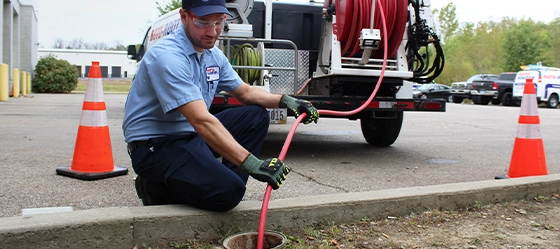
Nothing in a slab house is harder to get at than the pipe cast into the floor. Wiring runs in walls and attics. Supply lines can be rerouted overhead. The drain line was laid in a trench before the concrete went down, and from the day of the pour it has been sealed under the building. Almost every house and a great many commercial buildings in Houston are built exactly that way, which changes what this service is worth here. It is not only about clearing a blockage. It is about keeping a pipe you cannot reach in a condition that does not force anyone to reach it.
What Hydro Jetting Does to a Line Under Concrete
The work happens from an access point rather than through the floor. A nozzle on a hose is fed into the line and throws high-pressure water backward against the pipe wall as it travels, so the cleaning is a scour across the full circumference and loosened material moves back toward the cleanout instead of downstream. Grease that cooled along the crown comes off. Sludge settled in a flat stretch lifts and flushes. Mineral scale in older cast iron gets cut back toward the original bore, which is the descaling half of the work and the part that matters most on pipe of a certain age. Root hair left at a joint after a cutter head is stripped away.
A cable does something narrower. It opens a channel through the blockage, restores flow and leaves the coating in place, which is the right answer at midnight and the wrong answer as a plan.
Why the Camera Earns Its Keep Before the Concrete Does
Under a slab the camera is doing more than finding a clog. It is establishing whether the pipe is sound, and that answer decides whether the next conversation is about maintenance or about opening a floor. Nobody in Houston should be quoted a tunnel or a breakout on the strength of a description. A recorded pass gives the owner a location, a depth, a distance from the access point and a picture of the defect, which is enough to get a second opinion without paying twice for the same diagnosis.
The camera goes back down when the cleaning is done, and on a line nobody can see that second pass is the only proof the wall is clear rather than merely open.
Serving the entire Houston metro area, Including:
Counties in the Houston Metro Area
What Cleaning Cannot Fix Under a Slab
Cleaning assumes the pipe is intact, and three findings say it is not. A collapsed length has no bore left to clean. A joint offset far enough will stop the hose, and the problem there is structural. A wall thinned by long corrosion may not survive pressure. Any of the three means the honest recommendation is a repair conversation, which under a Texas slab covers real options: a tunnel from outside to reach the pipe without opening the floor, a lining approach where the run allows it, or a breakout where nothing else reaches. Those are different jobs with different estimates and they begin from footage rather than from guesswork.
What jetting does in that situation is still useful. A clean wall gives the camera a clear view, so the defect gets measured properly instead of estimated through a layer of grease.
Does Hydro Jetting Work on a Line Under a Slab?
Yes, and it is one of the better uses for it, because the alternative to keeping that line clean is eventually reaching it. The hose travels the run from a cleanout, the concrete is never touched, and the pipe is cleaned along its length. What the method cannot do is repair a break or lift a section that has settled. Those need access. Cleaning is what keeps a sound line from being confused with a failing one, and on Texas ground that moves, that distinction is worth making with a camera rather than an opinion.
Under a Restaurant Slab the Stakes Change
A kitchen run is larger, carries far more fat and food solids, and fails at the worst possible moment. It is also usually under a floor that cannot be opened without closing the room above it. That combination is why food service operators across Houston move to a planned interval instead of waiting: cleaning on a Tuesday morning is an inconvenience, and a floor breakout during a busy week is something else entirely. A residential line cleaned back to the wall can go years before it wants attention, and what caused the buildup decides how many.
For work that is not this service, the Houston plumbers page covers the rest of it.
What the Recording Is Worth on a Pipe You Cannot See
A homeowner in Houston who has had a line cleaned and filmed owns something the next technician cannot argue with: a baseline. Compare a run against its own footage a few years later and the question of whether it is getting worse actually has an answer. On a slab that is worth more than it sounds, because the decisions ahead are expensive ones and every alternative to evidence is somebody guessing at what the concrete is hiding. It is also the document to hand a buyer, an insurer or a landlord when the condition of the line becomes their question.
Where the Access Point Usually Sits
Most slab properties in Houston have an exterior cleanout somewhere near where the line leaves the building, and finding it is the first thing that happens. Landscaping, a patio poured over it, or an addition built across the run can bury one, and older houses sometimes never had one. None of that stops the work, but it changes the time and the approach, so it is worth mentioning on the phone. Where no cleanout exists, the inspection covers what installing one would take, which is a small job next to the alternative of having no way into the pipe at all.
If a line is backing up right now instead of gradually slowing, start with emergency plumbing help in Houston. Flow first, then the question of what the pipe is doing.
Call About a Line You Cannot See Under the Slab
Roto-Rooter has been in business since 1935, is fully licensed and insured, and answers in Houston 24/7, 365 days a year. Call 713-472-5554 or schedule online to get a camera into the run and a recorded account of its condition anywhere in Houston. Roto-Rooter provides on-site estimates before any work begins, and when the pipe is under concrete, knowing instead of guessing is where the plumbing peace of mind starts.

Signs the Trouble Is Under the Floor, Not in the Fixture
Gulf Coast Clay Under a City Built Flat

SPECIAL FINANCING AVAILABLE
We have partnered with Synchrony Bank to offer financing options to make your plumbing repair expenses as convenient and stress-free as possible.