Hydro Jetting in Gainesville
Key takeaways, for mains and branches: the case for cleaning the wall
A main line narrates its condition through the fixtures above it.
- Older galvanized and clay laterals carry decades of deposits, and age alone does not rule out cleaning while the pipe itself stays sound.
- Expansive clay soils move with moisture, and a joint that has shifted admits fine roots that a cutter alone will not keep out.
- A video camera inspection runs before any water moves, because fragile, collapsed or offset pipe has to be ruled out first.
- Grease that cools along the crown, mineral scale inside older cast iron, sludge in a flat run and root hair at a joint each need a different follow-up.
- Recurring roots at the same joint are a structural finding, and footage is what separates a cleaning that will hold from a repair conversation.
- Access decides a lot of the visit: a buried, landscaped-over or finished-around cleanout changes how the hose reaches the line.
- Building managers who keep inspection footage on file can show a plumber the line's history instead of describing it from memory.
- A line restored to something near its original diameter moves what it was built to move, usually across several fixtures at once.
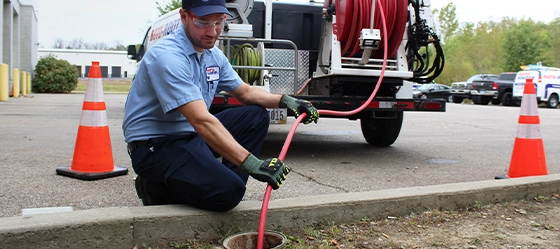
A drain that behaves differently by season is not being temperamental. It is being specific. The VA plumbing code frames the work, and the camera frames the day. For Gainesville readers, the next step is the camera, same as everywhere.
Circumference versus channel, the core difference
The tool at the center of this work is a hose with a purpose-built nozzle on its end. Water pushing out behind the head creates the thrust that moves it and, in the same stroke, rinses the wall surface it just traversed. Debris the head releases rides the returning stream toward the cleanout instead of being shoved deeper into the pipe. The result is a true 360-degree rinse, ceiling to floor of the pipe, spanning whatever distance the hose covers.
How each buildup forms, and where
Four deposits account for most of the work. Grease enters the system as warm liquid, gives up its heat downstream, and plates the crown and walls in a film that each rinse refreshes and thickens. Scale forms by precipitation instead of adhesion, hard-water minerals settling onto the pipe, and over the decades the cast iron closes in on its own flow. Sludge finds the flat spots and the bellies and stays put there, even as the water above keeps its pace. Fourth comes root hair: wisps entering through joints or cracks, widest at the opening that let them inside.
The two camera passes
The camera runs first for two reasons, and the second matters more than the first. The recording shows what fouled the line, and the method takes its shape from the showing. It determines fitness for the procedure as well, so a collapse, a dropped joint, a thin wall or a hanging run pauses the jetting plan in favor of repair options. Inspecting before jetting keeps the line safe from the jetting as much as it informs the jetting.
Reading the symptoms as a set
The pattern is more informative than the event. A lone clog that responds to one clearing is exactly that, lone. Two plug-ups in twelve months points at the pipe's interior; three upgrades it to an unwanted standing appointment. As clearings bunch up on the calendar, buildup has the momentum, and momentum is best answered by washing the wall rather than re-piercing the plug.
Serving Gainesville and surrounding communities, Including:
Counties in the Gainesville Area
The visit begins with the cleanout and ends with a record, and both belong to the customer. The pattern plays out in Gainesville on the VA calendar. The VA plumbing code frames what the work may involve. For Gainesville, the progression holds without modification.
When the camera says no to jetting
Some lines answer the jetting question with no, and the no is worth hearing early. A collapsed span offers the hose no bore at all. Misaligned joints snag the hose; behind the snag sits structural damage, not deposit. Corrosion-thinned walls sit closer to failure under the same pressure a sound line dismisses. Such conditions are precisely what the pre-work camera pass hunts for, and the discovery converts the visit into a repair consult with evidence on screen. For Gainesville, the progression holds without modification.
The commercial version of recurring trouble
A commercial kitchen writes its own schedule. Commercial cooking sends grease into the branch in solution at every meal, and the run's length gives it time to coat the pipe. An initial inspection yields the interval that matters, how fast this kitchen's branch soils between cleanings, shaped by volume, menu and interceptor capacity, and revisited whenever those change. For Gainesville, the progression holds without modification.
Living with a clean line
What changes after a real cleaning is capacity, and it shows up across the whole house at once. A tub that used to lag badly now handles the shower running wide open. The kitchen sink stays dry through every rinse cycle now. The bowl empties smoothly, air bubble gone. Nothing was swapped or upgraded; the shared drain simply stopped being mostly clogged.
Setting an interval from evidence
Preventive scheduling works when it is built from evidence, and the evidence is one inspection. Camera first: deposit located and measured. Clean second: timer reset. The next symptom then fixes the rhythm. From then on the pipe sets the pace, based on evidence rather than advertising.
The estimate conversation
Cost is set by what the camera finds, which is why it is quoted on-site and not over the phone. The work takes its shape from how far the line goes, how it is accessed, what has built up and over what distance. A short branch cleanout and a full lateral run are priced as the different jobs they are, with the camera drawing the line between them. With Roto-Rooter, the quote is built at the property and precedes any actual work.
What jetting cannot fix
When the footage rules cleaning out, nothing about the visit is wasted. The inspection that found the collapse is the same inspection a repair needs to plan from, so the day converts rather than ends. Roto-Rooter handles sewer line repair as its own scope of work, and the honesty runs in one direction only: no crew should pressure-wash a broken line to a clean-looking failure.
What shapes the quote
The estimate conversation happens with the footage on screen, which is the cleanest way to price anything: the scope is visible, the plan follows it, and the number describes work you can see the need for. Nothing in the process requires a deposit to learn what is wrong with your line.
Request Hydro Jetting for a Gainesville Line
Roto-Rooter is fully licensed and insured, and the company has done this work since 1935. Call 703-393-2219 or schedule online to arrange the camera inspection and the cleaning it points to. Other local work this team performs starts at the Gainesville plumbing page. If a line is backing up right now, start with emergency plumbing help in Gainesville and let the cleaning follow.

Hydro Jetting, By Symptom
Seasons, Soils and Sewer Lines

SPECIAL FINANCING AVAILABLE
We have partnered with Synchrony Bank to offer financing options to make your plumbing repair expenses as convenient and stress-free as possible.