Hydro Jetting in Dayton
Key Takeaways: A Line Can Be in Trouble With Nothing Showing in the Yard
- Coarse valley gravel takes water straight down, so a lateral leaking at a joint leaves no wet patch, no smell and no soft ground to point at.
- What the property owner gets instead is a symptom indoors: a fixture slowing, a backup that returns, a floor drain that takes the overflow.
- A video camera inspection is the only real evidence, and it comes before the hose for two reasons: to name the cause and to confirm the pipe can take pressure.
- Hydro jetting scours the sewer line back to the pipe wall around its full circumference, which is why buildup comes out rather than getting bored through.
- Grease, mineral scale in older cast iron, settled sludge and root hair left by a cutter head are four separate findings with four different answers.
- Descaling is the part of the work that gives an old iron line its bore back, and the second camera pass is what proves it happened.
- A collapsed or badly offset pipe is not a jetting candidate, and pressure applied to one accomplishes nothing.
- Roto-Rooter is fully licensed and insured, and answers in Dayton 24/7, 365 days a year.
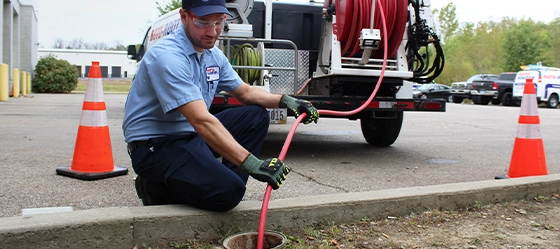
In some places a failing sewer line announces itself above ground. Grass grows greener over the run, a low spot stays soft for days after rain, a smell hangs around one corner of the yard. Here, mostly, it does not. The valley floor under Dayton is coarse sand and gravel laid down by meltwater, and it is permeable enough that anything escaping a cracked hub or an open joint goes straight down and out of sight. The line can be in real trouble for years while the lawn above it looks exactly like everybody else's.
Why the Yard Tells You Nothing
That matters because it changes what you can conclude from the outside. A Dayton homeowner with a repeat backup and a dry, ordinary yard reasonably assumes the pipe is intact and something is simply catching in it. Sometimes that is right. Sometimes there is a break admitting groundwater and fine grit, and the material piling up inside is arriving from the ground rather than from the house. The two look identical from the driveway and call for completely different work, which is the whole argument for putting a camera in the line before anybody quotes a solution.
It cuts the other way too. Plenty of lines under Dayton are simply dirty: decades of grease, a narrowed iron stack, roots at one seam. Those are cleaning jobs, and knowing that with certainty saves an owner from being talked into a repair the pipe does not need.
Hydro Jetting After the Camera, Not Before It
A cable is a boring and cutting tool. It opens a channel through a blockage and restores flow, and a cutter head takes the bulk of a root mass, which is exactly what is wanted when a house is out of service. Neither removes what is bonded to the pipe wall on either side. Hydro jetting does: a nozzle carried on a hose throws high-pressure water backward against the wall as the hose is drawn through, and the scour reaches the full circumference while loosened material travels back toward the access point rather than downstream. Grease along the crown lifts. Settled sludge and grit wash out. Mineral scale in older cast iron is cut back toward the original bore, the descaling side of the work. Root hair still anchored at a joint after the blade has been through is stripped away.
Serving the entire Dayton metro area, Including:
Counties in the Dayton Metro Area
The Findings Cleaning Cannot Fix
Pressure is a cleaning method, and it starts from the assumption that the pipe is still a pipe. Three findings end that assumption. A collapsed length has no bore left to clean. A joint offset far enough will catch the hose, and the trouble there is structural. A wall thinned by long corrosion may not survive the work at all. In every one of those cases the honest answer is that cleaning is not the fix, and the conversation moves to repair options with the footage as its starting point.
That is also where the invisible ground works in the owner's favor for once. A break that never surfaced can still be located precisely on camera, which means a repair under a Dayton driveway or an alley approach can be planned around a known point instead of an exploratory trench.
Is Hydro Jetting Worth Doing If the Line Is Already Cracked?
Sometimes, and the distinction is worth understanding. A hairline crack in an otherwise sound pipe does not rule out cleaning, and cleaning may be exactly what is needed so the crack can be seen and measured properly. A length that has broken, dropped or pulled apart is different, and pressure there risks making a bad situation worse. The camera pass is what tells the two apart, and a technician who has watched the footage will say which one you have before anything goes into the line.
The Diner on the Corner Has the Same Ground and More Volume
A house lateral and a commercial kitchen run differ in diameter, in daily load and in what a failure costs the owner. A residential line in Dayton cleaned back to the wall can go years before it wants attention again, and what caused the buildup decides how many. A kitchen pushing fat and food solids through the same pipe every day is working against a rate it can actually measure, which is why kitchen operators in Dayton tend to set an interval and clean on a slow morning rather than during a rush.
For plumbing work that is not this service, the Dayton plumbers page is the place to start.
Access on a Small Lot Served From an Alley
Where the crew gets into the pipe shapes the visit as much as what is in it. An exterior cleanout sitting in the open is the short version. Plenty of houses in Dayton went up before an outside cleanout was standard, and on a narrow lot with the run heading back toward an alley, the way in may be a stack inside the house or a fitting that has been finished over during a remodel. None of that stops the work. It changes the time it takes, so it is worth mentioning on the phone rather than discovering with a truck already parked. Where no cleanout exists at all, the inspection covers what adding one would involve, since a line that has needed attention twice in this Ohio ground will want it again.
What You Can Reasonably Conclude Without a Camera
Very little, and that is the point of this page. A recurring backup tells you something is wrong and nothing about what. Age of the Dayton house narrows it. The material of the pipe narrows it further. Beyond that, anyone offering a diagnosis from the curb is guessing, and a guess that leads to a dig in ground this loose is an expensive way to learn what a camera would have shown in twenty minutes.
If the line is backing up right now instead of slowly declining, start with emergency plumbing help in Dayton. Flow first, then the question of what is really going on.
Book the Camera Run the Yard Cannot Give You
Roto-Rooter has been in business since 1935, is fully licensed and insured, and answers in Dayton 24/7, 365 days a year. Call 937-434-4152 or schedule online to get eyes in the line and a straight account of what they found anywhere in Dayton. Roto-Rooter provides on-site estimates before any work begins, and on ground that hides everything, seeing the pipe is where the plumbing peace of mind comes from.

Symptoms That Show Up Indoors Instead of Outdoors
Gravel Under the Valley Floor, Houses Built Before the War

SPECIAL FINANCING AVAILABLE
We have partnered with Synchrony Bank to offer financing options to make your plumbing repair expenses as convenient and stress-free as possible.