Hydro Jetting in Dallas
Key Takeaways: Ground That Changes Size, and Joints That Do Not Stay Put
- Prairie clay under Dallas shrinks through a rainless summer and swells when the rain returns, and a buried lateral takes that movement at its joints.
- A small step where one length no longer lines up with the next is enough to stop paper and solids, and grease then builds behind whatever has stopped.
- Hydro jetting scours the sewer line back to the pipe wall around its full circumference, so the buildup comes out instead of being bored through.
- A cable restores flow through the pile and leaves the coating, which is why the same run closes again on roughly the same schedule.
- A video camera inspection comes first, to measure what has moved and to confirm the pipe can take pressure, and again afterward to show the wall is clear.
- Grease, mineral scale in older cast iron, sludge and root hair left by a cutter head are four separate findings, and descaling is what recovers a narrowed iron line.
- A collapsed length or a badly offset joint is not a jetting candidate, and pressure applied to one changes nothing.
- Roto-Rooter is fully licensed and insured, and answers in Dallas 24/7, 365 days a year.
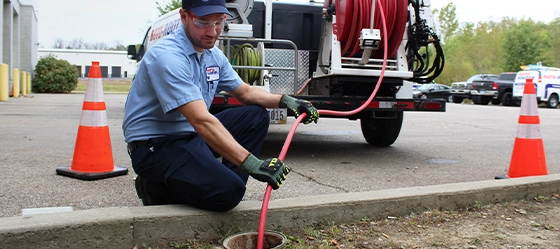
Blackland clay does not stay the same size all year. It gives up water through a long hot summer and contracts, cracks open across a lawn wide enough to lose a coin in, and then the rain comes and it takes the water back and expands again. Anybody who has watched a door stop closing properly in August and start again in November has seen it at work. What happens above ground also happens below it, and a sewer lateral buried in Dallas soil gets worked by that cycle year after year.
What a Joint That Has Moved Does to Everything Passing
Pipe handles that movement at its weakest points, which are the joints. On an older clay tile lateral in Dallas there is one every few feet. On newer plastic there are far fewer, and the connections at each end still take the strain. When a length shifts slightly out of line with the next, the result is a step: a small ledge across part of the opening. Water goes past it without difficulty. Paper folds against it, solids stall, and fat that would otherwise have kept moving finds an anchor and starts to build. The blockage that eventually stops the house sits in a foot or two of pipe rather than spread along the run, which is why it comes back to the same place every time.
How Far Hydro Jetting Gets on a Line That Has Moved
A nozzle carried on a hose throws high-pressure water backward against the pipe wall as it travels, so the cleaning reaches the full circumference and everything it loosens comes back toward the access point rather than heading downstream. Grease along the crown lifts. Settled sludge flushes. Mineral scale inside older cast iron is cut back toward the original bore, which is the descaling half of the work, and root hair left at a seam after a cutter head is stripped out. On a line with a step in it, the hose cleans right up to that point and the camera then shows precisely how big the step is.
Cleaning does not put the pipe back in line. Nothing that goes down a hose does. What it does is separate two situations that look identical from inside the house: a dirty pipe, which is a cleaning job, and a pipe that has moved, which is a decision about how long to keep cleaning it.
Serving the entire Dallas metro area, Including:
Counties in the Dallas Metro Area
The Findings That End the Cleaning Conversation
There is a point past which cleaning is the wrong recommendation anywhere in Texas, and an honest technician names it. A length that has collapsed has no bore left to work with. A joint offset far enough will catch the hose, and what is wrong there is structural rather than dirty. A wall thinned by long corrosion may not survive pressure at all. Each of those turns the discussion toward repair, and the footage from the inspection is what that discussion should be built on rather than a description over the phone.
Under a slab in Dallas, the options in that conversation usually include a tunnel from outside to reach the pipe without opening a floor, a lining approach where the run allows it, or a spot repair at the one joint that has failed. They are different jobs with different estimates, and knowing the exact location from the camera is what keeps the work small.
Does Hydro Jetting Help a Line That Keeps Separating?
It helps and it does not cure. Cleaning restores the bore and removes the material collecting at the step, which usually buys a long stretch of normal service. The step is still there, so the material will start collecting again, and the useful question is how quickly. A line in Dallas that stays clear for years is on a maintenance footing that many owners are content with. A line that closes twice in a season is telling you the movement has gone beyond what cleaning can carry, and the money is better spent on the joint than on the schedule.
Two Buildings on the Same Clay, Two Different Loads
A restaurant run and a house lateral sit in the same ground and face the same movement, but they are not the same job. The commercial line is larger, carries fat and food solids daily, and turns a small step into a closed pipe far faster. That is why operators across Dallas tend to set an interval and clean on a quiet morning instead of waiting for a Friday night. A residential line cleaned back to the wall can go years before it wants attention again, and what caused the buildup decides how many.
For work that is not this service, the Dallas plumbers page covers the rest of it.
What You Are Left Holding When It Is Done
Two things, and both are worth having. The first is bore: a pipe returned close to its original diameter carries what it was sized to carry, so the slow tub, the gurgle and the fixture that objects when the washing machine drains tend to resolve together. The second is a record. A Texas homeowner with recorded footage of a joint can compare against it after the next dry summer and see whether the step has grown, which turns a guess about foundation movement into a measurement.
Why the Same Season Brings the Same Call
Ground movement is seasonal, so the trouble it causes tends to be seasonal too. A household in Dallas that has needed a plumber at the end of two consecutive summers is not unlucky, it is watching a pattern, and a pattern is something you can plan around. Cleaning the line in Dallas and recording its condition before the dry stretch, rather than during the week it closes, turns an emergency into an appointment. It also produces a baseline, so the next inspection is a comparison rather than a fresh diagnosis.
If a line is backing up right now instead of gradually slowing, start with emergency plumbing help in Dallas. Flow first, then the question of what the ground has been doing to the pipe.
Book a Look at the Joint That Keeps Catching
Roto-Rooter has been in business since 1935, is fully licensed and insured, and answers in Dallas 24/7, 365 days a year. Call 972-986-1978 or schedule online to have the line cleaned and filmed, so the choice between maintaining it and repairing it is made on evidence. Roto-Rooter provides on-site estimates before any work begins, and that is where the plumbing peace of mind starts on soil that never sits still.

What Shows Up After a Long Dry Summer
Prairie Clay, and Two Seasons That Pull It Opposite Ways

SPECIAL FINANCING AVAILABLE
We have partnered with Synchrony Bank to offer financing options to make your plumbing repair expenses as convenient and stress-free as possible.