Sewer and Water Line Excavation in Cleveland
Key Takeaways: What Old Repairs Do to a Sewer Line Replacement
- A Cleveland run that keeps failing in a new place each time is not unlucky. It is a pipe made of several pipes, and the weak points are where one becomes another.
- Laterals under Cleveland housing have usually been opened before, for a repair, a service replacement or a street job, and each of those left a joint behind.
- The camera survey has to map the whole length, not just the blockage, because an unrecorded transition changes what any repair method can do.
- Cast iron spliced into a clay run does not behave like the clay around it, and finding one mid-run can rule out pipe bursting on its own.
- Every spot repair adds two more transitions, so the third patch on one lateral is worth considerably less than the first was.
- Utility locating precedes any excavation. Gas, electric, water and telecom are marked first, and in ground worked this many times the step takes longer.
- The job is permitted and inspected and Roto-Rooter runs that process. Roto-Rooter is fully licensed and insured.
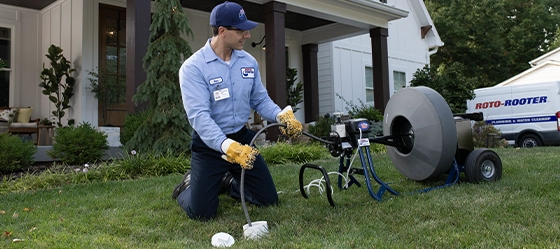
Ask what a sewer lateral is made of and the honest answer in Cleveland is usually more than one thing. A pipe that has been in the ground since the house went up has generally been cut into at least once, and whatever went in at that point is still there doing its job or failing at it.
Why a Line That Has Been Fixed Before Is Harder to Fix Again
A continuous run of one material fails in predictable ways. A Cleveland run assembled from three materials over three eras fails at the seams between them, because that is where the wall thickness changes, where the alignment was set by hand, and where whatever coupling was used has been carrying the difference ever since.
The standard structural findings still apply and still decide things. A collapse leaves no bore. A severe offset catches solids permanently. A belly holds standing water and reloads after every cleaning. Roots through a break are an opening rather than a blockage. What a patched run adds is a fifth reading: a transition that has separated, dropped, or been sleeved with something that was never meant to stay. On camera those look like a step in the pipe wall, and they are the single most useful thing to have documented, which is why a camera inspection here is worth running end to end before anyone quotes the work.
Where Pipe Bursting Meets Something It Did Not Expect
Open-cut is the direct method: a trench along the run, the old sewer lateral out, new pipe bedded in, then backfill and compaction. It is indifferent to what it finds, which on a patched line is worth something.
Trenchless is not indifferent. Pipe bursting pulls a new line along the path of the old one while a head splits the original outward, and that works beautifully on brittle material that fractures cleanly. It works far less well when the head arrives at a length of cast iron spliced in during an old Cleveland repair, at a concrete encasement, or at a steel repair sleeve, because those do not fracture the way clay does and the pull can stall in the ground. Lining has its own version of the problem: a liner needs a continuous host of reasonably even diameter, and a step at a transition is where it wrinkles or fails to seat. None of that rules trenchless out in Cleveland. It means the survey has to find the transitions first, which is why a full-length inspection is worth more here than a look at the blockage.
Serving the entire Cleveland metro area, Including:
Counties in the Cleveland Metro Area
The Locate Comes First, and It Takes Longer Here
Utility locating precedes any opening of the ground, without exception. Gas, electric, water and telecom all cross the corridor a sewer lateral occupies, and in a Cleveland neighborhood where that ground has been dug and refilled repeatedly across a century, records are thinner and the marking is slower. That is a reason to allow time for it, never a reason to compress it. Nothing is excavated until the marks are down.
The work is permitted and inspected, and Roto-Rooter handles that process rather than leaving it with the property owner. What is deliberately absent from this page is a permit fee or an approval timeline, because both vary between jurisdictions in Ohio and with the scope of the specific job, and a figure printed here would turn into a commitment nobody made. It is covered in the on-site estimate against the actual work.
Responsibility is worth pinning down early too. Generally the property owner owns the lateral out to the municipal main and the municipality owns the main, but where exactly that changes is set locally and varies, so confirm it rather than assuming. On a two-family building it also decides which owner is answering for the work. Roto-Rooter works on the property owner's side of that boundary and does not take on municipal main work.
Does Another Spot Repair Make Sense on This Run?
This is the question the page exists to answer honestly, because the easy answer sells more work and the right answer sometimes sells less. A spot repair opens one length, replaces it, and closes the Cleveland ground, and where the camera shows a single defect with sound pipe on both sides that is exactly the correct job.
The arithmetic changes once a run already carries two or three old repairs. Each patch introduces two new transitions, each transition is a candidate for the next failure, and the pipe between them is the same age it was last time. A Cleveland lateral on its fourth patch is being maintained rather than repaired. At some point replacing the whole length is cheaper than the sequence of visits, and the way to know where that point is falls out of the footage: count the transitions, look at the wall condition between them, and decide from what is there.
What an Excavation Opens Between the House and the Curb
Straight talk serves better than reassurance. An open cut in Cleveland disturbs the ground along its whole length, and on a narrow lot the run passes under a walk, a drive or the tree lawn before it reaches the main. Those surfaces come up and they will not look untouched afterward. Pipe bursting reduces the footprint to two pits where the line allows it, which is one more reason to establish early whether it does.
Backfill and compaction are part of the work, and they matter especially on ground that has been opened before, because the old trench is already a softer stripe through the Ohio till and closing the new one badly widens it. Final surface restoration, meaning turf, paving or hardscape, is scoped on site and agreed before work begins rather than assumed either way. Ask for it in writing.
What Happens If It Fails Again First
A run in this condition does not wait for a scheduled date. If it backs up before the work starts, emergency plumbing help in Cleveland can restore flow so the household keeps functioning. It is a holding action rather than a repair and it changes nothing about the footage. For the rest of what is handled locally, start at the Cleveland plumbers page.
Book the Survey That Maps Every Old Repair
Roto-Rooter has been diagnosing and replacing sewer lines since 1935 and is fully licensed and insured. Call 216-226-4506 or schedule online to have the full length of the Cleveland line put on camera, transitions included, before any method is proposed. Roto-Rooter provides on-site estimates before any work begins, so the footage and the scope arrive together. On a repair this size that is the plumbing peace of mind worth having, and Roto-Rooter answers 24/7, 365 days a year.

Joints, Couplings and the Places a Run Changes Material
Ground That Has Been Opened More Than Once

SPECIAL FINANCING AVAILABLE
We have partnered with Synchrony Bank to offer financing options to make your plumbing repair expenses as convenient and stress-free as possible.