Hydro Jetting in Charlotte
Key Takeaways: The Material Under the Yard Decides the Method
- Before anything else, somebody has to know what the pipe is made of. Clay, cast iron, fiber and PVC all answer to high-pressure water differently, and one of them does not answer to it at all.
- A cable bores an opening through a blockage and gets flow back. Everything bonded to the wall on either side of that opening is still there, which is why the drain closes again on roughly the same cycle.
- Hydro jetting scours the full circumference of the pipe back to the wall, so what returns is bore rather than a passage through the middle of a deposit.
- Grease, mineral scale and root hair remaining after a cutting head are three different findings, and a video camera inspection is what tells them apart.
- Charlotte has been building outward for a century, so the age and material of a sewer line track roughly with how far out the street sits, not with how the house looks.
- Some laterals of a certain vintage were laid in a bituminized fiber pipe that deforms rather than cracks. Pressure has no business in one, and the camera is how that gets caught.
- One slow fixture in the house is a smaller job than any of this. That is Charlotte drain cleaning.
- Roto-Rooter is fully licensed and insured and answers 24/7, 365 days a year.
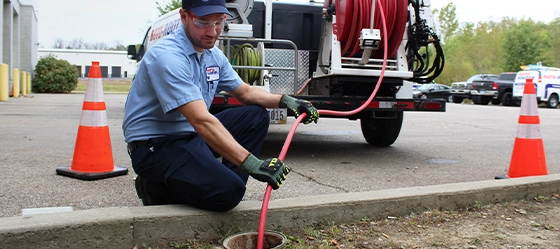
Two houses on the same street in Charlotte can have laterals separated by fifty years of plumbing practice, and neither owner has any way of knowing it from the surface. That is not a quirk. It is what happens when a city keeps annexing and keeps building, ring after ring, in whatever material the trade favored that decade.
What Hydro Jetting Does Inside a Sound Pipe
A hose carries a nozzle down the line, and the nozzle aims high-pressure water backward against the pipe wall while the hose is drawn along the run. The cleaning happens around the whole circumference rather than through the center, which is the difference between removing a deposit and making a hole in it. Grease that cooled and set along the crown comes off. Sludge in a stretch with little fall is carried out instead of pushed further along. Where cast iron has corroded inward, descaling takes the buildup back toward the bore the pipe was made with. Root hair left after a cutting head is stripped from the joint that admitted it.
All of that assumes a pipe that can hold its own shape while the water works. On clay in reasonable condition, on sound cast iron, on PVC, that assumption holds comfortably. It is not a universal assumption, which is the point of the next section.
Which Lines Should Never See High-Pressure Water?
Three conditions and one material. A collapsed section has no bore left to clean. A joint offset far enough that one length no longer meets the next will catch a hose, and the misalignment is the real fault anyway. A wall thinned by long corrosion may not survive the work. And a lateral laid in the bituminized fiber pipe used widely in postwar construction across North Carolina, sometimes still called by its trade name Orangeburg, fails by going oval under load rather than by breaking, so it is already deforming by the time anyone looks at it. Cleaning it is not on the table.
None of that is a reason for alarm and all of it is a reason to look first. A camera survey costs a fraction of what guessing costs, and across Charlotte, where what sits under the ground changes street to street, guessing is exactly what an inspection replaces.
Serving the entire Charlotte metro area, Including:
Counties in the Charlotte Metro Area
Where Hydro Jetting Stops Being an Option
It is worth being blunt about this, because the alternative is a customer who paid for pressure on a pipe that could not take it. When a camera finds a collapse, a bad offset, a wall gone thin, or fiber pipe already going out of round, the answer is that cleaning is not the remedy. Jetting cleans pipe. It does not repair pipe and it never has, and no amount of pressure turns one into the other.
What follows in those cases is a repair conversation, and the useful part is that it starts from footage rather than from a hunch. A lateral running under a front yard in Charlotte may be a candidate for a trenchless repair rather than an open dig, and that is a different job with a different estimate, quoted from what the camera already recorded.
House Lines and Commercial Lines Foul at Different Rates
A residential lateral and a working kitchen line differ in diameter, in daily loading and in what a failure costs. A house run in Charlotte cleaned properly back to the wall can go a long time before it needs anything again, and how long depends on what put the deposit there. A commercial kitchen putting service volume down the same pipe every day is working against a rate it can actually measure, which is why operators across North Carolina tend to settle on a planned interval rather than wait for the failure to pick its own moment.
Roto-Rooter handles both. For anything else a property here needs, start with Roto-Rooter in Charlotte.
Access, Cleanouts and What Slows a Visit Down
A technician locates the cleanout, runs the camera and talks through what is on the screen before any decision gets made. If the line is a candidate, the hose goes in, the affected stretch is cleaned, and the camera goes back down so the wall can be seen rather than described. Roto-Rooter provides on-site estimates before any work begins, so the scope and the number arrive at the same time.
Access is the practical variable. A cleanout sitting in the open makes for a short visit. One that has been landscaped over, decked around, or never installed changes the approach, and it is better raised on the phone than discovered in the yard. Where there is no cleanout at all, the inspection covers what adding one to North Carolina plumbing code would involve, because a line that has needed help twice will need it a third time.
What You Are Left Holding Afterward
Diameter first. A pipe returned to something near what it was laid at moves what it was sized to move, so the slow drain, the gurgle and the fixture that backs up when the washer empties tend to resolve together instead of one at a time. The second thing is a record. Footage of your own line, taken after cleaning, is a baseline, and an owner in Charlotte holding one can compare against it later instead of starting the diagnosis over.
If a line is backing up as you read this, cleaning is the wrong conversation for today. Start with emergency plumbing help in Charlotte, get the flow back, and take up the rest afterward.
Schedule a Sewer Line Inspection in Charlotte
Roto-Rooter has been clearing and cleaning drains since 1935, and is fully licensed and insured. Call 704-535-5303 or schedule online to find out what the pipe under your yard actually is before anyone decides how to treat it, and get the plumbing peace of mind that comes with knowing. Roto-Rooter answers 24/7, 365 days a year.

Six Signs a Line Needs Scouring, Not Snaking
A Century of Build Rings in One City

SPECIAL FINANCING AVAILABLE
We have partnered with Synchrony Bank to offer financing options to make your plumbing repair expenses as convenient and stress-free as possible.