Hydro Jetting in Camden
Key Takeaways: A Line Repaired Five Times Is Five Different Pipes
- A lateral that keeps failing at the same distance from the house is usually failing at a junction, not along a length of sound pipe.
- Old lines get repaired in whatever material the decade favored, so one run can hold clay, cast iron and plastic with couplings between them, and each junction is a change in diameter, wall thickness or alignment.
- Any lip inside a pipe catches solids, and once something stops there everything arriving behind it has a reason to stop too.
- A cable bores through what has collected on the lip and leaves the lip. Hydro jetting scours the full circumference back to the wall on both sides of it.
- A video camera inspection reads material changes instantly, which is why it answers in ten minutes what guessing has never answered in Camden or anywhere else.
- Grease, mineral scale and root hair after a cutting head still account for most of what a line carries, and tree roots are especially fond of a repair joint.
- One slow fixture is a different visit entirely. That is Camden drain cleaning.
- Roto-Rooter is fully licensed and insured and answers 24/7, 365 days a year.
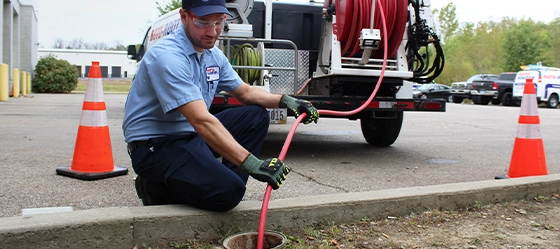
Very little pipe under an old lot in Camden is original all the way to the main. Something gets dug up, a section gets replaced, a coupling goes in, and forty years later somebody does it again a few feet further out. What ends up buried is not one line. It is a sequence of them, joined end to end by people who were each solving a different problem on a different day.
What a Transition Does to Everything Moving Past It
Pipe materials do not share a wall thickness. Clay is thick, cast iron is different again, and plastic is thinner than both, so joining them means the inside diameters do not line up even when the outside does. What you get at the junction is a step: a small shelf where the bore changes. Add a coupling that sits slightly proud, or two lengths that settled at marginally different rates over the decades, and the shelf gets larger.
Solids moving through a sewer line do not need much of an obstacle. A lip catches one piece of something fibrous, that piece catches the next, and within a season there is a mass sitting on a shelf that nothing about the pipe would otherwise explain. This is why a line can fail repeatedly at the same distance from the building while the pipe on either side of the failure is perfectly sound.
How Does Hydro Jetting Handle a Line of Mixed Materials?
It cleans across them, which a cable does not. A hose carries a nozzle that drives high-pressure water backward against the pipe wall as the hose is drawn through, so the working surface is the full circumference of whatever material happens to be there at that moment. Grease that has cooled and set along the crown comes off. Sludge held on a shelf is lifted and carried out rather than pushed onto the next one. Where cast iron has corroded inward, descaling takes the buildup back toward the bore. Root hair remaining after a cutting head is stripped from the joint that admitted it, and on a patched line that joint is very often a repair coupling.
What cleaning does not do is remove the step itself. That is geometry, and it belongs to the repair conversation rather than the maintenance one. But a cleaned line with a known step is a manageable thing, and an uninspected one is not.
Serving the entire Camden metro area, Including:
Counties in the Camden Metro Area
One more thing about Camden housing gets missed and matters here. A lot that has changed hands several times has usually had work done by several different people, and none of them left a drawing behind. That is the ordinary condition of an older American city rather than a reflection on anybody, but it does mean the only reliable record of what is under a Camden property is the one a camera makes, and until somebody makes it every quote on that line is a price put on an unknown.
The Repairs Cleaning Cannot Substitute For
Three findings take pressure off the table entirely. A collapsed section has no bore left to clean. A joint offset far enough that one length no longer meets the next will catch a hose, and the misalignment is the fault regardless of what has collected on it. A wall thinned by long corrosion may not survive the work. On a patched line there is a fourth, which is a coupling that has failed or shifted, and it presents the same way.
In any of those the honest answer is that cleaning is not the remedy. Jetting cleans a pipe and has never repaired one, and a company that pressurizes a failing line anyway has sold a customer a few quiet months. What follows instead is a repair conversation scoped from footage, which in Camden may mean replacing one bad junction rather than the whole run, and knowing which is worth a great deal.
Why a Commercial Run Compounds the Problem
Commercial lines are larger in diameter and carry far more every day than a house line does, so anything holding material in the run gets loaded faster. A residential lateral cleaned back to the wall can go a long time before it needs attention, depending on what put the deposit there. A kitchen putting service volume down a patched run is working against a rate it can measure, which is why operators across New Jersey generally come out ahead by cleaning once, looking at the footage, and setting an interval from what it shows.
Roto-Rooter covers both. For anything else a property here needs, start with Camden plumbers.
Getting a Camera Into a Line With No Modern Access
The visit begins wherever access exists. A technician finds the cleanout, runs the camera and talks through what is on the screen before anything is decided. If the line is a candidate, the hose goes in, the affected stretch is cleaned, and the camera goes back down so the wall can be seen rather than described. Roto-Rooter provides on-site estimates before any work begins.
On Camden housing this old the access point is the first problem to solve. Some lots never had an exterior cleanout, some had one that has since been paved over or built against, and on others the only way in is a fitting inside the building. Saying so on the phone saves time on the day. Where nothing usable exists, the inspection covers what adding an access point to New Jersey plumbing code would involve, and on a line with this much history that is usually the right investment.
What the Footage Settles
Bore comes back first, so the slow drain, the gurgle and the fixture that backs up when a washer empties tend to resolve together rather than one at a time. The second result is a map. On a spliced line, knowing where each material starts and ends, and which junction is the troublesome one, converts a vague and expensive-sounding problem into a specific and much smaller one. An owner in Camden holding that recording is in a far better position the next time anybody quotes work on it.
If a line is backing up right now, none of this is today's job. Start with emergency plumbing help in Camden and get the flow back before anything else.
Call to Get a Camera Down the Line in Camden
Roto-Rooter has been clearing and cleaning drains since 1935, and is fully licensed and insured. Call 856-235-3697 or schedule online to find out what the run is actually made of and where it changes, and get the plumbing peace of mind of a decision made from footage rather than from a guess. Roto-Rooter answers 24/7, 365 days a year.

Where Hydro Jetting Helps a Patched Line
A Century of Repairs Under One Narrow Lot

SPECIAL FINANCING AVAILABLE
We have partnered with Synchrony Bank to offer financing options to make your plumbing repair expenses as convenient and stress-free as possible.