Sewer and Water Line Excavation in Camden
Key Takeaways: Why Excavation Gets Decided at the Far End
- Backups that clear easily and return within months are reporting a defect in the pipe rather than a household habit, and only a camera separates the two.
- The last stretch of the run, where the lateral meets a main laid under the older streets of Camden, sits deeper than the rest of it and is the most demanding point on the job to reach.
- Four findings end the cleaning conversation wherever they sit: a collapsed length, a joint dropped out of alignment, a sag holding standing water, and roots entering through a break.
- Trenchless is conditional rather than an upgrade. Depth at the connection, the material of the existing pipe and usable access at both ends decide whether it can be used at all.
- Gas, water, electric and telecom share the corridor under a New Jersey street between the building and the curb, so utility locating comes before any excavation and is never skipped.
- Where the owner's responsibility ends is set by the municipality rather than by the contractor, and it is worth confirming before a scope is agreed.
- Camden sits on coastal plain sand and silt with no rock in it, which makes trenching straightforward and makes compaction the thing that decides whether the surface settles later.
- Roto-Rooter handles the permit and inspection process and is fully licensed and insured.
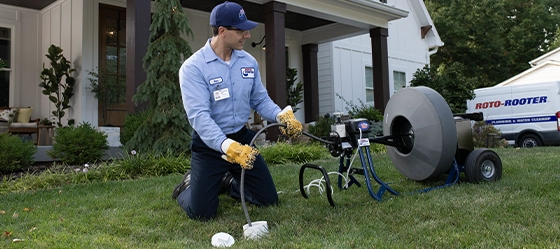
Almost every conversation about digging up a sewer line begins at the building, because the building is where the symptom shows. The decision is usually settled at the other end. Across Camden the run leaves the building, crosses the front of the lot, passes under the walk and the curb strip, and ties into a main laid under a street grid that was set out generations ago. That last stretch is the deepest and the least accessible part of the whole run.
What a Camera Survey Has to Reach
A survey that stops at the first obstruction has recorded the symptom and missed the cause. The camera has to travel the length of the lateral, past the point where the pipe leaves the property, down to the connection itself, because a run can be sound for eighty percent of its length and failed at the last joint. On the shorter frontages common across Camden that joint can be a few paces beyond the property line and still be the deepest point on the whole run. Distance readings come back with the footage, so a defect is recorded as a position on the ground rather than as a general impression, and that position is what an excavation plan is built from.
Four findings take cleaning off the table wherever they turn up. A collapsed length has no bore left to restore. A joint that has dropped out of line leaves a lip that catches everything moving past it and will keep doing so. A sag holding standing water refills after every cleaning, because gravity is the problem rather than the obstruction. Roots entering through a break are a symptom of an opening that will admit them again as soon as they are cut. When one of those sits in the final few feet, where Camden laterals run deepest, the job changes shape, because reaching it means opening the deepest part of the corridor.
Depth at the Connection Decides the Excavation Method
Open-cut is the direct approach: a trench along the run, the old pipe out, new pipe in, then backfill and compaction. It works on any condition of pipe, and its disruption is proportional to what sits above the line. Where the failure sits close to the building, the trench is short and stays inside a narrow Camden frontage. Where it is at the far end, the same repair means working near the walk and the curb strip at the greatest depth on the run.
Trenchless methods change that arithmetic. Pipe bursting pulls a new line along the path of the old one while breaking the original outward, working from pits at each end rather than along the whole length. Cured-in-place lining forms a new pipe wall inside the existing one. Both are genuinely less invasive, and neither is available on every line. Depth, the material and condition of the existing pipe, how far a collapse has gone, and whether there is usable access at both ends decide it, and those calls are made from footage rather than from a description over the phone.
Serving the entire Camden metro area, Including:
Counties in the Camden Metro Area
How Far Does a Sewer Line Replacement Have to Reach?
Not every structural finding means replacing the whole lateral. Where the camera shows one failed joint or a single crushed length in an otherwise sound run, a spot repair opens only that section and is a substantially smaller job. What decides between the two is the condition of the pipe either side of the defect, and on a run that has been in Camden ground for many decades, a line with one clean defect is less common than a line with several.
Distance matters as much as condition, and that is the part people do not expect. A defect ten feet from the building is a modest opening in a front garden. The same defect at the tap is the deepest excavation on the job. Replacing the run through to that point can be the more sensible answer even when part of the pipe is still serviceable, because opening the far end twice is worse than opening it once. The footage and the distance readings are what that judgment is made from, and Roto-Rooter provides on-site estimates before any work begins.
Nothing Opens at the Curb Until Every Service Is Marked
Every buried service in a New Jersey street shares the corridor a sewer lateral runs through. Gas, water, electric and telecom are all in there, and in a city that has been adding utilities to the same narrow right of way for well over a century, they are not always where a plan says they are. Locates are requested and the marks go down before anything is excavated. That is a safety and legal obligation rather than a courtesy, and anybody offering to skip it to save a day is offering to take a risk with a gas line and with your property.
The work is permitted and inspected, and Roto-Rooter handles that process as part of the job under New Jersey plumbing code. What is deliberately absent from this page is what a permit costs or how long an approval runs, because both vary by jurisdiction and by the scope of the specific work, and a number printed here would become a promise nobody authorized. Your on-site estimate covers it against the actual job.
The Tap Is Where Ownership Changes Hands
The pipe running from the building out to the municipal main is generally the property owner's, and the main is generally the municipality's. Where the boundary sits, at the property line, at the walk, at the curb, or at the tap itself, is set locally and it varies. Confirm it with your municipality before a scope is agreed rather than after, because it decides who pays for which length of pipe and it is the single most common misunderstanding on a job this size.
Roto-Rooter works on the property owner's side of that boundary. Municipal main work is not something a plumbing company undertakes, and if the survey points at the main rather than at the lateral, the next call is to the city rather than to a contractor. That is worth knowing before an excavation is planned, because a defect in the main will not be cured by replacing a sound lateral.
What the Trench Line Looks Like a Year Later
An open cut across the shallow front setback typical of Camden lots disturbs the ground along its whole length, and where the run crosses a walk, a drive or the curb strip, that surface has to be opened and will not be invisible afterward. Trenchless reduces the footprint substantially, which is why it is worth asking about, though the pits at each end are still excavations and one of them sits at the deep end.
The work includes backfill and compaction, and in the sandy coastal plain ground under Camden that matters more than it sounds. Loose backfill keeps settling for months after the crew leaves and reports itself as a depression running the length of the trench, which is the complaint people remember long after the pipe is working again. Final surface restoration, meaning turf, paving or hardscape, is scoped on site and agreed before work starts rather than assumed. Ask for it to be spelled out, and get the answer before the estimate is signed.
Backups Between the Survey and the Repair
A line bad enough to need replacing rarely waits politely for the appointment. If it backs up in the meantime, emergency plumbing help in Camden can restore flow so the household keeps functioning, though that is a holding action and it does not change what the camera found. For everything else Roto-Rooter handles locally, start at the Camden plumbers page.
Request an Excavation Estimate Built on Footage
Sewer and water line excavation in Camden is the largest job on this page and the one that deserves the most evidence behind it. Call 856-235-3697 or schedule online, and Roto-Rooter will run a camera the full length of the lateral, including the last few feet nobody sees. Roto-Rooter has been in the plumbing business since 1935, is fully licensed and insured, and provides on-site estimates before any work begins. Somebody answers 24/7, 365 days a year, which on a line already failing is the plumbing peace of mind that counts.

What Turns Up in the Last Few Feet
Coastal Plain Ground and an Early Street Grid

SPECIAL FINANCING AVAILABLE
We have partnered with Synchrony Bank to offer financing options to make your plumbing repair expenses as convenient and stress-free as possible.