Sewer and Water Line Excavation in Buffalo
Key Takeaways: What Frozen Ground Changes About an Excavation
- A line that has been rodded clear more than once and backs up anyway is reporting a failed pipe, not a dirty one, and no amount of further cleaning changes that.
- The camera goes in before anything else. Footage is what separates an obstruction that can be removed from a pipe that has to come out of the ground.
- Frost reaches well down into Western New York ground, so a Buffalo sewer lateral is set low and the trench is deeper than the size of the pipe would suggest.
- Winter does not cancel the work. It changes it: frozen overburden to break through, spoil that will not spread, and turf that cannot be reseeded until spring.
- Trenchless is a condition, not an upgrade. Depth, the material of the existing pipe, how far it has collapsed and whether there is access at both ends all decide it.
- Utility locating comes before any excavation. Gas, electric, water and telecom are marked first, and snow cover makes that step slower rather than optional.
- The job is permitted and inspected, and Roto-Rooter runs that process. Roto-Rooter is fully licensed and insured.
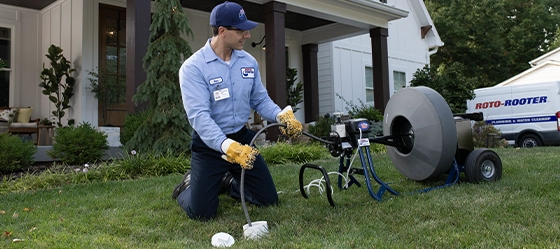
An excavation gets decided twice in Buffalo. Once by what the camera finds inside the pipe, and once by the month on the calendar, because ground that locks up for a long stretch of the year is a different medium to work in than ground that never freezes.
Does a Sewer Line Have to Be Replaced Before Winter?
Not automatically, and anyone answering that question without footage is guessing. What the survey establishes is whether the pipe still has a bore that can be kept open. A line with buildup and sound walls can be cleaned and will hold. A line with a structural defect will keep failing on its own schedule, and in Buffalo that is the one worth settling before the ground hardens.
Four findings take cleaning off the table. A collapsed length has no shape left to restore. A severe offset, where one section has shifted out of line with the next, leaves a lip that catches solids and goes on catching them. A belly holds standing water at the low point, so the run refills after every cleaning because the grade is the fault. Root intrusion through a broken joint is an opening, and cutting the roots leaves the opening exactly where it was.
Open-Cut and Pipe Bursting on a Line That Sits Low
Open-cut is the direct method: a trench along the run, the old sewer lateral out, new pipe bedded in, then backfill and compaction. It works on any condition the camera finds, and its cost to the property is measured in what is on the surface above the pipe.
Trenchless narrows that footprint. Pipe bursting pulls a new line along the path of the old one while a head breaks the original outward into the surrounding ground, working from a pit at each end instead of a trench along the whole length. Lining cures a new wall inside a host pipe that is still round enough to accept it. Depth matters here more than in a mild climate, because a lateral set below a deep frost line means deeper entry pits, and the camera footage is what any honest answer about method is built on.
Serving the entire Buffalo metro area, Including:
Counties in the Buffalo Metro Area
Before the Bucket Touches Frozen Ground
Utility locating happens first in Buffalo and it is not a formality. Gas, electric, water and telecom all share the ground a sewer lateral crosses, and marking them is a safety and legal obligation rather than a courtesy. Snow cover slows the marking work down, which is a reason to start it earlier and never a reason to skip it. Nothing gets opened until the marks are down and readable, and anyone offering to save a day by working around that is offering to take a risk with a gas line and with your property.
The work is permitted and inspected, and Roto-Rooter handles that process as part of the job rather than leaving it with the property owner. What is deliberately not printed here is what a permit costs or how long an approval runs, because both vary between jurisdictions in New York and with the scope of the specific job, and a figure on a page turns into a promise nobody made. The on-site estimate covers it against the actual work.
Responsibility for the pipe is worth settling early as well. The run from the building out to the municipal main is generally the property owner's and the main itself is generally the municipality's, but the exact point where one becomes the other is set locally and varies. Confirm it with your municipality rather than assuming, because it decides who pays, and in Buffalo it is the single most common misunderstanding on a job this size. Roto-Rooter works on the owner's side of that boundary, and municipal main work is not something a plumbing company takes on.
What the Yard Looks Like After a Winter Excavation
Being straight about this beats being reassuring. An open cut disturbs the ground along its whole length, and on the tight Buffalo lots described above the run passes under a driveway, a walk or a set of front steps more often than it passes under open lawn. Those surfaces have to come up and they will not be invisible afterward. Pipe bursting reduces the footprint to the two entry pits, which is exactly why it is worth asking whether the line qualifies for it.
Backfill and compaction are part of the work, and they matter more in this climate than they sound. Loosely compacted fill settles for months and leaves a depression tracking the trench line, and a cut closed in frozen weather cannot be finished the way a summer cut can, because frozen spoil going back into a trench leaves voids as it thaws. Final surface restoration, meaning turf, paving or hardscape, is scoped on site and agreed before work starts rather than assumed, and in cold months the seeding half of it waits for the ground.
Replacing a Section Against Replacing the Run
A structural finding does not always mean the whole lateral comes out. Where the camera shows one failed joint or a single crushed length in a pipe that is otherwise sound, a spot repair opens only that stretch. What decides between the two is the condition of everything either side of the defect.
This is where the footage earns its keep a second time. A line with one fault and clean wall on both sides of it is a different proposition from a line showing three separations and heavy scale, and on the old clay under Buffalo, which has been through decades of freeze and thaw working every joint equally, the second pattern is common enough to be worth looking for specifically before a spot repair is agreed. Replacing eight feet of a run that is failing along its whole length buys a season and a second excavation.
When the Line Gives Out Before the Dig Is Booked
A pipe bad enough to need replacing rarely waits politely for an appointment. If it backs up in the meantime, emergency plumbing help in Buffalo can restore flow for the moment so the household keeps running. That is a holding action, not a repair, and it does not change a thing about what the camera found. For the rest of what Roto-Rooter handles across Western New York, start at the Buffalo plumbers page.
Schedule the Camera Work Before the Ground Freezes
Roto-Rooter has been solving sewer problems since 1935 and is fully licensed and insured. Call 716-648-5082 or schedule online to book a camera inspection of the Buffalo line in question. Roto-Rooter provides on-site estimates before any work begins, so the footage and the scope arrive together and the decision comes off evidence. On a repair this size that is the plumbing peace of mind worth having, and Roto-Rooter answers 24/7, 365 days a year.

Reading the Line Before the Ground Locks Up
Snow Cover, Frozen Overburden and the Working Season

SPECIAL FINANCING AVAILABLE
We have partnered with Synchrony Bank to offer financing options to make your plumbing repair expenses as convenient and stress-free as possible.