Hydro Jetting in Boston
Key Takeaways: Soft Water, Old Iron and What Is Really Narrowing the Pipe
- The water supplied to Boston is soft, so a line that keeps closing here is rarely closing because of lime, and the easy explanation is the wrong one.
- What narrows an old waste line instead is corrosion on the inside of cast iron, and grease that grips a rough wall far better than a smooth one.
- Hydro jetting scours the sewer line back to the pipe wall around its full circumference, which takes off the coating rather than boring through it.
- A cable restores flow and leaves the buildup, which is why a run cleared that way closes again at the rate it filled the first time.
- A video camera inspection comes first, to identify what is on the wall and to confirm the pipe can take pressure, and returns afterward to prove the result.
- Descaling is the term for taking that crust back toward the original bore, and on iron of this age it is most of the value in the visit.
- A collapsed length or a joint that has dropped out of line is not a jetting candidate, and pressure will not rescue one.
- Roto-Rooter is fully licensed and insured, and answers in Boston 24/7, 365 days a year.
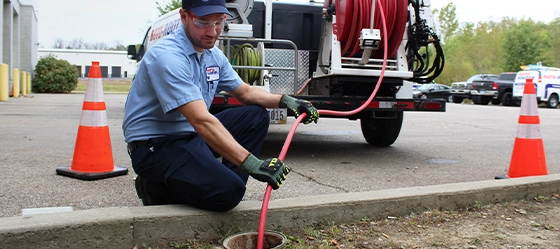
The water that arrives at a tap in Boston is soft. It comes from reservoirs out in the western part of the state, it carries very little dissolved mineral, and it is one of the reasons kettles here do not fur up the way they do in limestone country. That fact rules out the explanation people reach for first when a drain keeps closing. Whatever is narrowing the pipe under an old building in this city, it is not lime deposited out of hard water. Mineral scale of that kind is a problem for cities that draw their water off limestone, and it is not the problem here.
If It Is Not Lime, What Is on the Wall?
Three things, usually. The first is the iron itself. A cast iron waste line corrodes from the inside over decades and the corrosion is not smooth: it builds a rough, crusted surface that reduces the bore and gives everything passing something to catch on. The second is grease, which struggles to hold on to clean pipe and holds very well to a wall like that. The third is whatever the household or the tenants have sent down over the years, caught on the first two. Between them they narrow a line steadily enough that nobody notices until two fixtures cannot run at the same time, which is the complaint behind a good share of Boston calls.
Tree roots belong in the picture as well, though they enter at joints in the buried run rather than in the stack, and they arrive with their own diagnosis.
What Hydro Jetting Takes Off a Rough Iron Wall
A nozzle on a hose throws high-pressure water backward against the pipe wall as the hose is drawn through the run, so the cleaning is a scour across the full circumference and the material it lifts travels back toward the access point rather than downstream. On the old iron under Boston the effect is specific: the crust is cut back toward the original bore, which is descaling, and the grease that had bonded to it comes away with it. Settled sludge in a flat stretch flushes out. Root hair still anchored at a joint after a cutter head has been through is stripped away.
The camera goes down before that happens and again after. On a pipe this old the before matters most, because the wall thickness left in an iron line is the difference between a cleaning job and a replacement conversation, and only footage settles it.
Serving the entire Boston metro area, Including:
Counties in the Boston Metro Area
Where Cleaning Gives Way to Replacement
Iron does not last forever, and the honest limit on this service is what the pipe has left. Three findings end the cleaning conversation. A length that has collapsed has no bore to recover. A joint dropped or offset far enough will catch the hose, and the trouble there is structural. A wall corroded thin will not survive pressure, and on a waste line of real age that is a genuine possibility rather than a formality. The camera is what tells the difference, which is precisely why it goes down first.
When one of those turns up, what follows is a repair or replacement discussion built on the footage. In a dense Boston block that conversation includes options a suburban property would not need: working through a cellar rather than a Boston street, lining a run instead of opening a sidewalk, and coordinating with neighbors when the line runs under shared ground.
Can Iron That Old Take Hydro Jetting?
Sound cast iron takes it well, and it is the material that benefits most, because the crust narrowing it is exactly what the method removes. Iron already thinned by corrosion is a different case and the answer there is no. There is no way to tell the two apart from a fixture upstairs, which is the whole argument for the inspection. A technician who has watched the footage will say which one is in the building before anything goes into the line, and saying no when the pipe cannot take it is part of doing the job properly.
An Old Kitchen on Older Iron
Commercial and residential lines age differently even in the same building. A restaurant or cafe run is larger, carries fat and food solids every service, and turns a rough wall into a closed pipe far faster than a household does. That is why operators across Boston tend to work to an interval and clean on a slow morning rather than wait for a night when the room is full. A residential line cleaned back to the wall can run for years before it wants attention again, and what caused the buildup is what decides how many.
For plumbing work that is not this service, the Boston plumbers page is the place to start.
Getting a Hose Into a Building With No Front Yard
Access is the practical constraint in a city built this tightly. The way into a Boston line may not be outdoors at all. It may be a cleanout at the base of a stack rather than anything outside, and reaching it can mean going through a cellar, a shared entry or a back alley. Older buildings sometimes have no exterior cleanout at all. None of that prevents the work, and it does change how long it takes and who needs to be told in advance, so it is worth raising when you call. On a building in multiple occupancy it is also worth knowing who is authorized to approve work on a shared line before the crew is standing in the hall.
If a line is backing up right now rather than gradually slowing, start with emergency plumbing help in Boston. Flow first, then the question of what the pipe is actually carrying.
Call About the Iron Under an Old Boston Building
Roto-Rooter has been in business since 1935, is fully licensed and insured, and answers in Boston 24/7, 365 days a year. Call 617-267-0033 or schedule online to have the line filmed before anybody decides what it needs. Crews cover Boston every day of the week and through the night. Roto-Rooter provides on-site estimates before any work begins, and on pipe this old, knowing how much wall is left is where the plumbing peace of mind comes from.

Findings on a Waste Line That Came With the Building
Made Ground, Old Iron and a Winter That Reaches Down

SPECIAL FINANCING AVAILABLE
We have partnered with Synchrony Bank to offer financing options to make your plumbing repair expenses as convenient and stress-free as possible.