Sewer and Water Line Excavation in Boston
Key Takeaways: Groundwater, Old Pipe and Why Excavation Gets Wet Here
- A Boston line that surcharges during a wet spell and behaves in a dry one is usually taking groundwater in through a defect, not just struggling to push waste out.
- A camera inspection comes first. The survey separates a bore blocked by something removable from a pipe that has cracked open, and those two produce identical symptoms.
- Much of Boston stands on filled ground with the water table close beneath it, so an open trench starts filling from the sides and has to be pumped down and held.
- Saturated Boston fill will not stand up on its own. The sides of an excavation get shored or sloped back, which is why the surface disruption is wider than the pipe is.
- Utility locating happens before any digging and is not optional. Gas, electric, water and telecom all get marked, and in dense older ground there is more down there than the plans show.
- Where the property owner's sewer lateral ends and the municipal main begins is set locally, so treat it as a question for your municipality rather than a given.
- The work is permitted and inspected and Roto-Rooter handles that process. Roto-Rooter is fully licensed and insured.
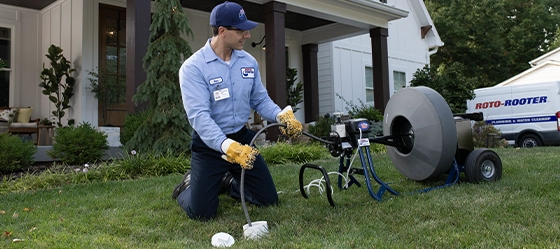
Water moves both ways through a broken pipe. That is the fact that makes sewer work in Boston read differently from the same job somewhere the ground is dry, because a lateral here can sit at or below the level the groundwater reaches, and a crack in it is an opening in both directions. Waste struggles to get out and clean groundwater comes steadily in, which is a real load on a line that was sized for a household rather than for a hillside of drainage. Older Massachusetts stock sits in that condition all over the city.
Does Groundwater Get Into a Cracked Sewer Line?
Continuously, when the defect sits below the water table. The trade calls it infiltration, and it is one of the more useful diagnostic clues available, because it changes with the weather. A line that backs up during a long wet stretch and behaves itself through a dry month is telling you something a line with a simple blockage never does, and it is one of the most common excavation calls in Boston. Fine soil travels in with that water, settles out in the bore, and builds the very obstruction that gets blamed for the backup.
A camera survey is what turns that suspicion into a finding. Footage shows whether water is entering at a joint, whether a section has lost its round, whether a run has dropped into a sag that will hold standing water regardless of the weather, and whether roots have taken the opening a crack offers them. Those are four different conditions and only some of them end in a trench.
Digging Below the Water Table Without Losing the Trench
Excavating in wet ground is a different discipline from excavating in dry ground. Water arrives from the sides of the cut faster than it can be ignored, so the excavation is dewatered while it stays open and the walls are shored or benched back so the soil does not run. None of that is exotic and all of it takes room, which is the first honest thing to say about what an open cut costs a small Massachusetts lot in surface.
It also affects the bedding. Pipe set in a wet trench needs a prepared bed that will not wash out from under it, and backfill placed in a wet cut has to be compacted in a way that accounts for water still in the ground. This is where corners get cut on a cheap job, and it is where a repair that settles two winters later comes from.
Serving the entire Boston metro area, Including:
Counties in the Boston Metro Area
The Locate Comes First, the Pump Comes Second
Nothing opens until the marks are down. Gas, electric, water and telecom share the corridor a sewer lateral occupies, and in ground that has been built on, dug up and built on again for centuries there is frequently more below the surface than any drawing admits, including services long out of use. Utility locating is a legal and safety obligation, and anyone offering to skip it to gain a day is proposing to gamble with a gas line.
The job is permitted and inspected and Roto-Rooter handles that process as part of the work. What you will not find on this page is a permit figure or an approval timeline, because both vary by jurisdiction across the Boston area and by the scope of the individual job, and a number published here becomes a promise nobody authorized. Your on-site estimate covers it against the real work.
How Far Out Does Your Pipe Actually Go?
The general division is that the lateral running from the building to the municipal main belongs to the property owner and the main belongs to the municipality. Precisely where that changes hands, at the property line, at the curb or at the connection, is set locally and it varies between jurisdictions in Massachusetts as everywhere else. Confirm yours before agreeing to work, because it settles who pays for which length.
Roto-Rooter works the property owner's side of that boundary. Municipal main work is not something a plumbing company undertakes, so when the survey points past the connection the next call is to the city rather than to a contractor.
Putting a Wet Trench Back So That It Stays Put
Backfilling a Boston cut in saturated ground rewards care and punishes speed. Spoil returned wet and loose will consolidate over the following seasons and leave a line across the yard or a dip in the paving, which is the complaint people remember long after they have forgotten the pipe. Compaction in lifts on a prepared bed is what prevents it, and asking specifically how the backfill will be placed is a fair question to put to any contractor.
Above that, expect candor rather than comfort. A trench across a small yard is visible for a season. A cut through a walk, a drive or an apron is patched and stays visible. Trenchless reduces the footprint to access pits at each end where the ground and the pipe allow it. Final surface restoration, meaning turf, paving or hardscape, is scoped on site and written into the estimate rather than assumed either way.
Spot Repair on a Line That Is Taking On Water
Where the camera finds one open joint or a single failed section in a run that is otherwise sound, a spot repair opens only that length and is a far smaller job than a sewer line replacement on a cramped Boston parcel. That is a real and frequent outcome, and it is worth asking for directly rather than waiting to be offered it.
What argues the other way is infiltration showing at several points along the run. Water entering in more than one place says the whole line has opened up rather than failed at a spot, and sealing one joint in that picture moves the problem a few feet downstream. Ask how many entry points the footage shows, because that count is the difference between the two jobs.
A Temporary Fix While the Repair Waits
A line this compromised does not schedule itself politely. If it surcharges before the excavation date, Boston emergency plumbing help can restore flow so the household keeps functioning, with the understanding that clearing a line that is taking on groundwater is a holding action rather than a repair. For everything else handled locally, start with Roto-Rooter in Boston.
Request a Camera Survey Before the Next Wet Stretch
If the trouble tracks the weather, that is diagnostic information and it is worth acting on. Call 617-267-0033 or schedule online for a survey of your Boston line that finds where water is entering and puts a distance on it. Roto-Rooter provides on-site estimates before any work begins, so the scope and the footage reach you together and the decision is made from evidence. Roto-Rooter is fully licensed and insured, has worked on Massachusetts sewer and drain lines since 1935, and answers 24/7, 365 days a year, which on a repair of this size is most of the plumbing peace of mind available.

Filled Ground and a Water Table That Never Drops Far
Why Pipe Bursting Behaves Differently in Saturated Ground

SPECIAL FINANCING AVAILABLE
We have partnered with Synchrony Bank to offer financing options to make your plumbing repair expenses as convenient and stress-free as possible.