Hydro Jetting in Baltimore
Key Takeaways: What Decades of Scale Do to a Rowhouse Stack
- Old cast iron rarely fails by breaking. It narrows, losing bore from the wall inward a little each year, until an ordinary week of laundry and showers is more than the pipe can carry.
- A cable does very little about that. It punches through whatever finally plugged the narrowed section and leaves the buildup that narrowed it, which is why relief measured in weeks is normal after snaking a scaled line.
- Hydro jetting cuts scale back toward the bore the pipe was cast with and takes grease and sludge off the wall in the same pass. Descaling is the part of this service most people have never had done.
- Rowhouse blocks in Baltimore were plumbed all at once, to one standard, so the lateral three doors down is the same age and the same material as yours and tends to fail on the same timetable.
- Tree roots and scale show up together in Baltimore. A jointed clay run under a mature street canopy admits root hair, and the scale further up the line is a separate problem found on the same pass.
- A wall already thinned by long corrosion is not a jetting candidate. That is a repair conversation, and the video camera inspection is what tells the two apart before any water goes in.
- Roto-Rooter is fully licensed and insured and works across Maryland 24/7, 365 days a year.
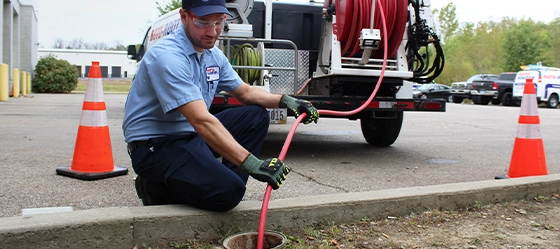
Scale never announces itself. A cast iron stack in a Baltimore rowhouse does not clog on a Tuesday, it gives up a fraction of its bore every year for decades and the household quietly adapts. The tub drains a little slower each winter. The basement floor drain burps when the washer empties. By the time anything actually backs up, the pipe has been running at a fraction of its diameter for a long while, and a cable pushed through it buys about a week.
How Hydro Jetting Descales Cast Iron
The distinction that matters is between opening a pipe and cleaning one. A cable is a boring tool: it locates the plug, cuts a channel through it, and flow returns. Everything responsible for the plug, the corrosion products layered on the wall, the grease set into them, the sludge sitting in the flat part of the run, is still there when the technician leaves, and the channel begins closing again at the rate it originally formed.
High-pressure water attacks the wall instead of the middle. The nozzle drives water outward and behind itself as the hose is drawn back through the sewer line, so the whole circumference is worked rather than one bored path. On cast iron that means scale is cut back toward the original bore, which is descaling proper. On the clay further out it means grease lifted off the crown, sludge carried away instead of shoved along, and root hair stripped from the seam a cutter head already opened. A pipe cleaned to its wall from one end of the run to the other is a different object from a pipe with a hole through the blockage.
Why the Same Spot Fails Twice on One Block
Because the block was built as one job. A row went up together, was plumbed together, and has aged together, so the low point, the long horizontal stretch, and the joint that sits under the heaviest tree are in roughly the same place in every house on it. Neighbors in Baltimore compare notes about backups and conclude that the whole street has bad plumbing. What the street actually has is one specification, installed once, now the same number of decades old.
That is useful information rather than bad news. It means a technician who has cleaned two laterals on a block has a fair idea of what the third one looks like, and it means the condition of your line is knowable rather than mysterious. It does not mean the work can be assumed, which is the next section.
Serving the entire Baltimore metro area, Including:
Counties in the Baltimore Metro Area
What the Camera Has to Show Before Any Water Goes In
On a street where every lateral is the same age, the footage is the only thing that distinguishes your pipe from your neighbor's. A video camera inspection runs the line first, and it is doing two separate jobs. It identifies what is on the wall, because scale, grease and root hair each imply different work, and on Maryland stock of this age two of the three turn up together. It also grades the pipe itself, because high-pressure water assumes a wall sound enough to be cleaned against.
The camera goes back down at the end of the job. A before-and-after on the same run is the only honest evidence that a wall is actually clear, and it leaves the household with recorded footage to compare against in a few years instead of starting the diagnosis from nothing. Any company doing this work should be willing to show both passes without being asked twice.
Will Jetting Damage a Pipe That Is Already Thin?
On a sound pipe, no. The pressure is directed at what is stuck to the wall, and cast iron or clay in decent condition takes it as a matter of routine. On a pipe that is not sound, the honest answer is that it should never get that far, which is the entire reason the camera goes first. Three findings take a line out of consideration: a collapsed section with no bore left to clean, a joint dropped or shifted far enough that the run no longer lines up, and a wall corroded thin enough that cleaning it is a gamble nobody should take with somebody else's house.
When the footage shows one of those, cleaning is not the fix and the conversation moves to repair. On a Baltimore rowhouse that conversation has to account for where the line runs, because a lateral crossing under a pavement or an alley behind a party wall is a different excavation from one under an open yard. It is separate work with its own estimate, and it starts from footage that has already been shot. If a fixture is backing up while you are reading this, the first call is to an emergency plumber in Baltimore, and the cleaning decision follows once flow is back.
Carryouts, Corner Kitchens and the Case for an Interval
A house lateral and a commercial kitchen line are different in diameter, in how fast they load up, and in what a failure costs the person holding the lease. A cleaned residential run in a Baltimore rowhouse can go years before it wants attention again, depending on what put the buildup there. A kitchen sending cooking waste down the same pipe every day is working against a rate it can measure, which is why operators tend to set an interval off the condition found at the first inspection and adjust from there.
Roto-Rooter covers both. For grease management, scheduled maintenance and the rest of what the local team handles across Baltimore, the Baltimore market page is where to start.
Call for a Camera Inspection in Baltimore
Roto-Rooter has been in sewer lines since 1935, works throughout Maryland, and is fully licensed and insured. Call 410-864-0435 or schedule online to get a camera down the line and find out what is actually on the wall. Roto-Rooter provides on-site estimates before any work begins, answers in Baltimore 24/7, 365 days a year, and the plumbing peace of mind on this one comes from having seen the pipe rather than from hoping about it.

When Jetting Is the Right Call for an Old Stack
Party Walls, Alley Runs and a Sewer Laid With the Block

SPECIAL FINANCING AVAILABLE
We have partnered with Synchrony Bank to offer financing options to make your plumbing repair expenses as convenient and stress-free as possible.