Hydro Jetting in Arlington
Key Takeaways: When One Sewer Lateral Serves Six Front Doors
- A line that closes again within months of being snaked was never cleaned. A cable bores an opening through the blockage and leaves the grease and scale bonded to the pipe wall exactly where they were.
- Hydro jetting works the full circumference of the pipe rather than the middle of it, which is why it answers a recurring backup instead of a single slow fixture.
- Much of the housing in Arlington shares its drainage. A courtyard block or a duplex runs one sewer line out to the street, so what one kitchen pours away turns up in everybody's lowest drain.
- A video camera inspection goes first and does two jobs: it finds what fouled the run, and it confirms the pipe can take high-pressure water at all.
- Grease, mineral scale and the root hair left after a cutter head are three different problems with three different causes, and the footage is what separates them.
- Some lines are not candidates. A collapsed or badly offset pipe needs a repair conversation, and descaling a wall that has already gone thin is not work worth buying.
- Roto-Rooter is fully licensed and insured, and answers across Virginia 24/7, 365 days a year.
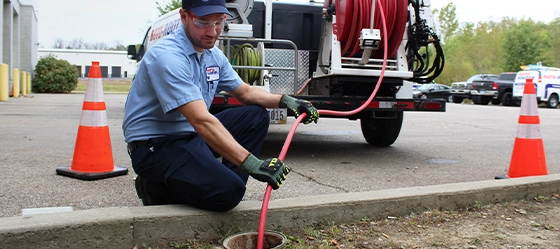
A sewer backup in a detached house is one household's bad evening. Across a good deal of Arlington it is four households' bad evening at once, because the brick courtyard apartments, the duplexes and the small garden blocks that fill the county were plumbed with a single lateral running out to the street. When that run closes down, the ground-floor fixtures go first and everybody upstairs finds out inside the hour.
That arrangement changes what a proper cleaning is worth. Restoring flow buys the building a season. Taking the pipe back to its wall buys it years, and on a shared line the difference gets measured in how many neighbors have to be home for the next visit.
What Hydro Jetting Removes That a Cable Leaves Behind
A cable is a boring and cutting tool. It finds the obstruction, chews an opening through it and gets water moving again, which is the correct answer at two in the morning. What it cannot touch is the layer of grease, sludge or mineral scale bonded to the pipe wall on either side of that opening. The channel it made closes at whatever rate the buildup formed in the first place, which is why the calendar between backups stays about the same length.
Jetting reverses that logic. The nozzle on the end of the hose throws water outward and backward against the wall, and the hose is drawn through the run so that every inch of the circumference gets worked rather than the path of least resistance down the center. Hardened grease lifts off the crown. Sludge settled into a flat stretch is carried out instead of pushed ahead of the tool. Mineral scale in cast iron is cut back toward the bore the pipe started with, which is the descaling side of the job. Root hair still anchored at a joint after a cutter head has been through is stripped off it. Clearing a clog ends tonight. Cleaning a sewer line end to end, wall included, changes what happens next year.
What the Camera Finds Under a Shared Courtyard Run
On a shared lateral the first question is rarely technical. It is whose problem this is, and the footage answers that before it answers anything else. A blockage forty feet out past the foundation belongs to the building; a grease plug in one branch belongs to one unit. That is the practical reason a video camera inspection happens before the hose comes off the truck, and it is worth insisting on even when somebody offers to skip it.
The technical reasons stack on top. The cause of the buildup decides what the right work is, and the pipe about to take high-pressure water gets screened for whether it can. Under an older building in Arlington the same pass routinely shows two unrelated problems: tree roots through a clay joint out in the yard, and scale narrowing the cast iron closer to the wall of the house. Those need different handling, and on the older Arlington laterals it is common enough to find both on one pass. The camera goes back down when the work is finished, because a before-and-after on the same run is the only honest way to show a pipe wall is clear, and on a shared line it is also what settles the argument among owners about whether the money accomplished anything.
Serving the entire Arlington metro area, Including:
Counties in the Arlington Metro Area
The Lines Jetting Cannot Save
High-pressure water cleans, and cleaning is all it does. So the inspection doubles as a screening, and it screens out three things. A run that has collapsed has nothing left to clean, only a void where the pipe used to carry. A joint that has dropped or shifted far out of line will snag a hose and, more to the point, is a structural fault that no amount of washing addresses. A wall thinned by decades of corrosion may simply not hold, and on cast iron of the vintage common in Virginia that is the finding worth having before the work rather than during it.
When the footage shows any of the three, the honest answer is that cleaning is not the fix and the conversation turns to repair. Under a built-out block in Arlington that conversation usually starts with what can be done without opening the whole run, because there is rarely much ground between a courtyard wall and the curb. It is a different job with its own estimate, and it begins from footage that already exists.
Kitchens That Run Seven Days a Week
A house lateral and a restaurant kitchen line are not the same job. They differ in diameter, in how fast they foul, and in what a failure costs the person who owns them. A residential run in Arlington that has been cleaned properly can go years before it needs attention again, depending on what put the buildup there. A kitchen pushing cooking waste through the same pipe every day is working against a known accumulation rate, which is why operators along the county's Metro corridors move to a planned interval rather than waiting for a Friday night failure.
Roto-Rooter handles both sides of that in Arlington. For grease management, scheduled maintenance and the rest of everything Roto-Rooter does in Arlington, the market page is the place to start.
Can High-Pressure Water Split an Old Clay Joint?
This is the question that stops most bookings, and it deserves a straight answer. On a line the camera has already cleared, no: the pressure is aimed at what is stuck to the wall, not at the pipe, and sound clay and cast iron take it routinely. On a line nobody has looked at, the truthful answer is that nobody can tell you, and that is really the answer to the whole question. A technician quoting a jetting job without putting a camera down the sewer line first is guessing with somebody else's pipe.
If a fixture is backing up while you read this, cleaning is the second conversation rather than the first. Start with 24/7 emergency plumbing in Arlington, get flow restored, and carry the footage from that visit into the decision about the wall.
Schedule a Line Inspection in Arlington
Roto-Rooter has been clearing and cleaning sewer lines since 1935, works across Virginia, and is fully licensed and insured. Call 703-253-7782 or schedule online to put a camera in the line before anything else happens. Roto-Rooter provides on-site estimates before any work begins, and answers in Arlington 24/7, 365 days a year.

Signs a Shared Line Is Due for Jetting
Brick Courtyard Blocks Under a Canopy That Never Left

SPECIAL FINANCING AVAILABLE
We have partnered with Synchrony Bank to offer financing options to make your plumbing repair expenses as convenient and stress-free as possible.